Reading: Where to even start!?

Hi Everyone.

This post is part rant, part a need for encouragement and part seeking advice. Be gentle with me please.

I use a lot of different tools for Japanese (usually trial and error to see what works best for me) and at the moment my learning is structured like this:

  • Wanikani for kanji and vocaublary (with KaniWani thrown in) -10 lessons a day in the evenings and reviews when they are due.
  • Marumori for grammar (I have Bunpro but I never got into it and prefer how Marumori is structured) - 1 lesson every 2-3 days and reviews when they are due.
  • Preply Japanese lessons once a week for speaking and listening - Going through Genki 1
  • Satori reader & Paperback manga (Yotubato and Delicious in Dungeon) for reading
  • Lingodeer and Plus (because Duolingo was not the one for me)

Sometimes I use Kanji Damage for mnemonics when I just cant get it to stick and when I mix up kanji that look alike

When I hit level 15, I was struggling to remember the kanji and vocabulary and realized it was probably a combination of multitasking and cognitive overload that was causing me to not retain anything at all. I would draw a complete blank during reviews, which was rather demotivating. I’ve taken quite a long break from lessons before and plan to do so again to focus on my reading this time; however, I’m finding that I’m even more demotivated with the break than last time because I find reading (and grammar to some extent) extremely difficult.

I’m attempting (and failing if Im honest) to read 聞き耳ラジオ on Satori, and I spend 10 minutes on a sentence, only to end up moving on (giving up?) anyway because I don’t understand most of what it’s saying. Yotubato has its own set of issues for me because (a) it’s largely hiragana, and honestly, sentences composed mostly of hiragana scare me (which is so odd because I’m no Kanji champ either :roll_eyes:) and (b) Ive been spoilt by the ability to quickly look up phrases/grammar in Satori which I cant do on Bilingual Manga/Paperback, thereby extending my 10 minutes per sentence to 30 and adding to the spiral of demotivation. I opened Delicious in Dungeon, looked at the first page then closed it :melting_face:

I absolutely love sumo wrestling and watch it in Japanese, technical terms like 決まり手 and 上手投げ, help me remember vocabulary like “decide” and “throw” with no issues. Shoutout to @RoseWagsBlue for the Sumo Appreciation Thread BTW! Though I will say the pessimist in me feels like i’m not using my love for the sport to the fullest, given just how much I watch, my listening is still very poor.

I guess just feel a bit deflated because I dont feel like Im getting anywhere towards my goal of actually reading. I put a lot into my studying because I genuinely love the language and culture, and I have set a goal to one day read this book in Japanese. I stare at it on my shelf longingly like a crazy person. :sweat_smile:

What can I do to make reading a more enjoyable experience? Heck, how did you go about reading in the first place?
Are there any other resources I should use (beyond user scripts, graded readers)?
Does it get better? When will it get better?
Will stepping away from everything for a little bit help with clarity?

13 Likes

Then here’s a good free manga you might like:

This is just one of the many series of free educational manga on

Lots and lots of them! Here are just some:

https://www3.nhk.or.jp/news/easy/

It sure does; as for when – I’d say it happens gradually. The more you read – the easier it becomes, but it’s a long process. So, I’d recommend to just relax and read things that you find interesting!

Anyway, best of luck with your studies! wricat

13 Likes

Well… while graded readers may be useful, they may also be uninteresting.
Now that you do have some Satori experience under the belt, why not just dive straight into a novel?
I found また、同じ夢を見ていた to be a good one to start with it, if that type of story tickles your fancy.
But.
Consider read it (and any other next X books) in electronic format, using Yomitan and whenever needed machine translation. They certainly can make the act of reading native content more enjoyable, however just make sure you don’t abuse them.

I don’t think that is uncommon. While it didn’t happen to me in the early levels, I’m feeling it now in the mid-30 ones. Taking breaks from new lessons is fine as long as you do your reviews (regardless of accuracy), and don’t let that discourage you.

I’m complaining A LOT about this :rofl: (well, not about actually reading but the quality of how I read and take it all in) but honestly… it does get better, I promise! :blush:

8 Likes

I just started reading, tbh. At first I joined the book clubs here in the forums, there is even an Absolute Beginner Book Club with very easy material, and with the help of everybody it’s not as hard as it may seem at first. But not gonna lie, the first few books will be HARD because you are not familiar with the vocab and grammar, and you need a plan how to work on that. (Some people just let it sink in and read enough that it eventually sticks, other people use anki or torii or something else to learn the vocab as they go, or even up-front via jdpb or something).

14 Likes

The first thing I read through in Japanese was the visual novel style game 逆転検事, from the Ace Attorney franchise.

It took me :sparkles: n i n e m o n t h s :sparkles:

I had played an English fan translation of it, so I could focus on reading while having a general idea of what was going on. Starting with things I already knew was essential for me to improve my Japanese. Too demotivating to struggle that hard and still not know what’s going on.

I started off WK level 18-ish? I only knew a few words per sentence. I would read a few days or weeks, drift away to focus on more grammar, kanji and vocab, and then come back to it. Rinse and repeat.

By the end, at level 60 (I think?) and having slogged away at Japanese the whole time, I was playing the game for fun. Understood 90-100% of any given text box.

I feel like there is no easy, painless way to start with reading and listening. For me, known material in JP was the bridge I desperately needed.

And stubbornness. I needed to be so stubborn about it.

13 Likes

To be exact, I don’t know, but Natively Forum really leans toward long time learners. learnnatively.com

I’d have to guess that the biggest problem right now isn’t vocab or Kanji pronunciation (in selected materials), but rather, meaning of phrases and interpretation of grammar?

In that case, Japanese Language > Book Clubs might be the best place. Or at least, attempt not to read too much explanation in Satori. It’s really too close at hand.

Maybe the answer to remember grammar, is to struggle to parse, before proofreading your attempts.

And then, take time to learn.


For some other books, you might really need more vocab. So, it might be recommended to read a mixture of easier books (grammar first) and harder books (vocab/Kanji first).

Or you might just use WaniKani or some SRS for vocab/Kanji, for the time being.

7 Likes

In short there is no shortcut to reading.
What you experience is lacking all the skills you did not practice yet (sentence parsing, context inference, ability to tolerate ambiguity etc).

Reading will be painful deciphering for a long time but it get easier with practice.

In case you did not already read it: Joining the Absolute Beginner Book Club: Preparation and First Reading Experience Expectations

Like you graded readers just don’t do it for me so I’m working with what I like.
I’m very slowing going through ひぐらしのなく頃に 第一話 鬼隠し編 上 | L33 the process is to prepare the text enough to have the necessary vocab to go page after page. In the first 6 months this represent a bit more than 21/328 novel pages but I already got 49.66% of the total kanji needed to read the book and am just shy of 24% of the total vocab.

What I would do in your place if you can tolerate it is to work on your sumo book as primary material and do the same thing.
Extract the text, learn the needed vocab and kanji (I documented here a step-by-step process to have a custom JPDB SRS deck) for the small next milestone (start with one or two sentence a day and then scale accordingly) and then get to it.

It is long, painful and wonderful.

The good bit is that it won’t get harder ever because you will already be working on your final goal and week after week you’ll be able to see how easier it is to progress.

===

edit: more stuff with an example analysis

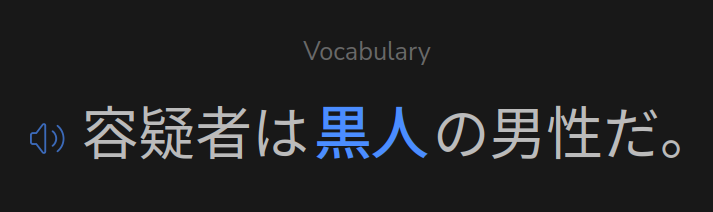
Something that helped me a lot was to update my SRS practice and to ALWAYS parse a sentence for each term like the process will be

  • Do i understand all the sentence intuitively ? (nope)
  • What is the gist of it ?
    I recognize 容 as (form, contains, look)
    疑 (doubt, distrust, suspicion)
    者 (person)

    黒人 (black person)

    男性 (man | gender)
    だ。
    So from this i understand that the sentence is roughly
    (容疑者)(topic maker)(a black male)(is)
    From this my guess was that “容疑者” was a “police inspector” (person who mistrust)
    … turn out i’m wrong it was “suspect” but that not important what is important is that the unknown part was reduced significanly.

If you do that a thousand times you’ll see that you can infer the context of a LOT of sentences (and you start to recognize sentences and grammar pattern).

Not gonna lie the first hundreds of sentences are extremely painful. But this is what reading is and every thousand sentences trains your brain to do it better, faster stronger

12 Likes

I’m partial to Yomujp still. They provide enough visuals that you don’t need an english translation to understand the meaning and you learn a lot about Japanese culture and scenic spots once you get to the N4 level materials. I usually read each article 3 times: 1st with the audio, 2nd time with audio and pausing to shadow, 3rd time reading aloud by myself. The annual subscription is super cheap too.

Also I don’t find the gaming style study apps all that helpful. If you want to read, it’s simply better to practice with graded readers. Brain learns better with context. I’m currently just doing WaniKani, Yomujp and reading Sailor Moon manga (which is geared toward elementary-middle school kids so I’m not having to look up kanji or grammar too often).

9 Likes

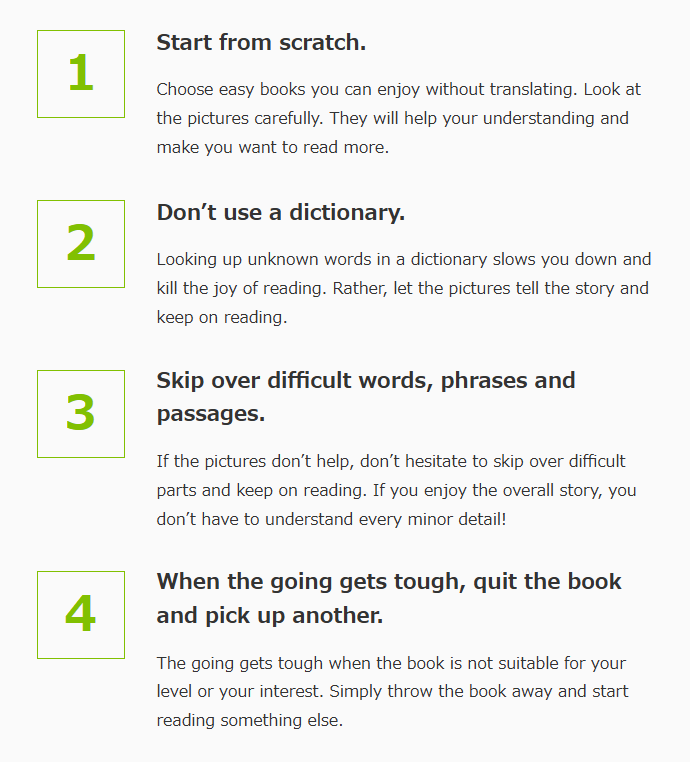
Tadoku have a library of free books for beginners, many of which have audio clips alongside them. They’re easily accessible graded readers, and you’re supposed to approach them with these golden rules in mind:

I also just finished watching this video on reading tips:

The beginning is particularly difficult because it’s written in sort of old legend style, IIRC. I read the first couple of pages with my husband but also couldn’t get into it.

I do encourage you to stick with Yotsubato. It gets really funny when it starts slotting into place in your brain. But it is hard to get to that stage from 0.

8 Likes

tbh, grammar helps. But it helps better after reading has already started for a while. That is, keep up with Tadoku style for a while. (Guide to Japanese, or Learn Japanese the Manga Way, may help, but never expect perfection.)

Nothing is painful if you don’t feel pain. Enjoyment is a matter of choice. Wasting time with ambiguity a little, maybe, but not really. It is required for initiation, then take time to improve.

I generally avoid parallel readers, or having another copy of English. Do it Japanese only.

6 Likes

Stumbled upon this book today:

It is at a really beginner level – sufficiently more beginner than 学研キッズネット、but it is fun, so I’d recommend reading through the free preview.

2 Likes

Regarding the act of reading:

It may have already been mentioned, but there is a really excellent thread by @ChristopherFritz about preparing to read your first book that helped me immensely when I began to read my first manga.

The two pieces of advice that have stuck with me ever since are these:

Your first book won’t be read fluidly or easily, it will be a pain to get through while you look up pretty much every other word. You might not even feel very accomplished when you finish because it will have felt like work. This experience is essential. Embrace it!

In your next few books, you’ll notice you are only looking up every third or fourth word. In the books after that, you might only be looking up a few words per page. This is the hill we have all climbed to get to a place where it no longer feels like work to read.


How to find books:

  • Browse Natively books under level 20 here (if there is a WK or BC symbol next to the name, there is an associated book club that you can join)

  • Check out Tadoku free graded readers here (seems like you may be familiar with these, but they range from ultra-beginner one-sentencers to actually interesting stories with dialogue and plot)

  • Scroll the Master List of WK Book Clubs here (use the threads to help guide you and don’t be afraid to revive an old thread for new questions)

:bullseye: Probably the most important aspect is that you are actually interested in whatever you choose to read. Reading an item from any level will be impossible if you find it dead boring.

My first book was the manga version of 君の名は because I’d just watched the movie at the time. It being Natively level 23 it was definitely too high of a level to otherwise comfortably be my first book, but my interest was strong enough that I genuinely did not mind looking up 90% of the words.

If you know that you’ll be slowly deciphering and only moderately understanding, an uninteresting premise will just make it torturous. Drop that Satori story if you don’t want to read it, there’s no sense in forcing yourself through something you hate. Instead, use that Natively link above to browse for books that look similar to Dungeon Meshi.


And, finally, if you want concrete visual evidence of improving your reading level (or you just enjoy building tables), try setting something up like @meagstudies’ Level+1 Reading Challenge :chart_increasing: :books:

This is where you challenge yourself to read a book at a certain Natively level (say, Level 12) and have the second book be the next level up, 13, and then 14, and so on. If you keep track as you climb the ladder, every completed level is a visible win :fire:

Check out some examples here, here, and here (shameless self-promo :flushed_face:)

I know this is yet another novel-length reply to your questions, but we truly have all been in your shoes! Don’t stop reading! :nerd_face: :open_book:

19 Likes

What Tai actually means is that you should read the Japanese translation of The Very Hungry Caterpillar

11 Likes

hmm…I sense bingo options coming soon :wink:
though bummed… :eyes:

where’s the solstice/equinox links :books:
winter autumn is coming :leaf_fluttering_in_wind:

one thing I have noticed personally…reading manga helps, but it’s not the same as reading shosetu…feel like I learn more from shosetu than reading manga (at this point in my reading) though I still read lots more manga than shosetu (probably need to work on that)

3 Likes

I start on the first page normally

14 Likes

I think to just start reading is good advice - I probably wouldn’t pick that specific book! It sounds like the OP was struggling with the graded readers too. I think また,同じ。。。 benefits from more grammar knowledge etc., I actually found it quite tough!

6 Likes

I would second this. I read it when it was pretty close to my ideal level and just would have struggled with it before then. It’s got meandering sentences and a main character who likes to make word play both in the narration and to other characters.

I’d probably recommend some of the short story anthologies that are a bit easier ふしぎ駄菓子屋 銭天堂 1 | L23, 世にも奇妙な商品カタログ 1 インスタント死神・友だちクジ他 | L23, and https://learnnatively.com/book/5e4c0015fe/ are fairly popular.

There are also some novels that are graded even easier than these (the Magic Treehouse books come to mind) on Natively, which are about the level of harder graded readers.

But it really comes down to what kind of reading experience motivates you. Do you want to read something that you’re more likely to enjoy but struggle with every single word, or would you like something that’s closer to your experience with Satori Reader? There’s not a right answer, but that can help you decide how to move forward.

5 Likes

Hi! After reading your post, I think, your problem here is that you expect too much of yourself in regards to reading, and your selection of material is probably unsuited to your current ability. Reading in itself takes practice and it will start pretty painfully. Don’t beat yourself up for not understanding everything at first go, that’s totally normal. As an adult, or at least as someone with an advanced understanding of another language, it feels uncomfortable to start from zero in a new language.

Delicious in Dungeon is serialized in Harta, it’s aimed at adults and most likely won’t be an easy read if you’re already struggling at reading. I’m not sure why Yotsubato is scary because of the hiragana? Can you dig deeper about why is it scary? Or maybe it’s just not interesting enough to you and that’s OK. I too, tried Yotsubato and didn’t stick because I was just not interested (even though I did enjoy the series in my native language years ago).

Do you have a shonen / shoujo manga that you already like, and already read in English or your native language? For example, if you enjoyed Naruto, try reading in Japanese and see if you can understand anything. The shounen/shoujo part is important since these are aimed at teens and therefore will have furigana on top of the kanji unlike Delicious in Dungeon which is seinen.

I don’t know what type of learner you are, but for myself, the key to progressing in reading is to find something in which the enjoyment or curiosity is more than the discomfort of not understanding. In my case, in the middle of the pandemic I started reading a manga in Japanese with my N5 ability and it was a struggle. I had to look up the dictionary for every speech bubble. But I was adamant to continue since I like that series (it was partially translated but not licensed or translated in real time), and I just want to know how the story goes. I probably got a lot of things wrong, but the beautiful thing about manga is that a lot of the story is visual. There is a lot of context that you can gleam in each page. With every chapter, I learned new grammar, kanji, and vocabulary. I don’t remember all of them now - but I still picked up many things.

My point is, it will get better with a lot of practice, but it will take time and patience. Find something that hits the sweet spot of being challenging but worth the struggle. Don’t be too hard on yourself or be discouraged from small discomfort. Think of every kanji, grammar, etc that you have to look up as a discovery and not a burden or a proof that you are not progressing. It is the way to progress itself!

10 Likes

Satori recommends that beginners try their Human Japanese Extra Credit. They are just single sentences but worth doing.

If you think you are making progress with your other resources, learning what Japanese sentences are like etc. maybe you can put reading stories/manga/novels on hold for a while. Be sure to keep doing more than just kanji and vocab. Reading will still be hard when you get back to it, but it gets better with a lot of consistent effort.

3 Likes

Looking at your details, I think you’re generally doing too much, and need to limit yourself a bit. Doing Marumori, Lingodeer, AND Genki is redundant. I recommend pairing things down to WK for kanji, Genki for grammar/vocab.

When it comes to “being ready to read.” I believe you ought to finish Genki 1 & 2 before jumping into reading unless your ok doing 10+ look-ups every page. The short reading at the end of Genki 2 will tell you if you are ready or not. I was able to fully understand it, and from there I started reading manga and doing look-ups and try to use content you are already familiar with in English or your native language. For example, I loved My Hero Academia and One Punch and just made small goals to read a couple pages a day, then a chapter a day, then a couple chapters a day, then a volume a day.

But that’s my analysis, you’re not there yet and you’re burdening yourself with too much that you’re going to burn out or lose motivation quite easily. Limitations will help you be more realistic about your goals and expected outcomes.

6 Likes