p. 175
In this way, spacesuits make long time activities in outer space possible, for various tasks to be done(?).
そのため、宇宙服の重さは、百キログラムを越えます。
Therefore, the weight of a spacesuit exceeds 100 kg.
地上ではとても動けませんが、宇宙では重さを感じないため、ただ動きにくいだけなのです。
On earth it can’t be moved at all, but in space the weight is not felt, it’s just difficult to move.
In the last sentence I expected something like @IgorTheGreat wrote (that you could ordinarily move) but the text seems to say the contrary (動きにくい - difficult to move).
I think yours is more in line with what is being said. In a space suit you are still moving slow and it’s hard to navigate.
Cathm2
July 1, 2020, 2:27pm
144
P175
このように、うちゅうふくは、うちゅう空間で 長時間 活動できるように、さまざまな くふうが されています。
In this way spacesuits, to carry out such activities in outer space for a long time, various innovations have been made.
(Last phrase courtesy of google translate as I couldn’t make sense of it. May be wrong.)
そのため、うちゅうふくの おもさは、百キログラムを こえます。
Because of this, a spacesuit’s weight exceeds a hundred kilograms.
地上では とても うごけませんが、うちゅうでは おもさを かんじないため、ただ うごきにくいだけなのです。
So on earth you can’t move very much, in space you don’t feel the weight, but it is still difficult to move.
Micki
July 1, 2020, 6:38pm
145
Cathm2:
さまざまな くふうが されています
Yes that looks right to me:
Not completely sure about the grammar at the end of the last sentence but I think you’ve got the gist of it.
Cathm2
July 2, 2020, 1:03pm
146
P176
うちゅう人は ほんとうに いるの?
うちゅうには、数えきれないほどの、たくさんの 星が あります。
In space, there are countless stars (planets?).
わたしたちが すんでいる 地球も、うちゅうの 中の 星の ひとつです。
The earth on which we live is just one of many planets in space.
では、人間が すむ 地球のように、うちゅう人が すんでいる 星は、ほかにも あるのでしょうか。
So, like the earth humans live on, there must be other planets with aliens living on them.
Pg. 176
宇宙には、数えきれないほどの、たくさんの 星が あります。
In space, there are countless numbers of planets.
私たちが 住んでいる 地球も、宇宙の 中の 星の 一つです。
The earth we live in is also one of those planets.
では、人間が すむ 地球のように、宇宙人が 住んでいる 星は、他にも あるのでしょうか。
Then, do aliens live in another planet similar to the earth that humans live in?
p. 176
宇宙には、数え切れないほどの、たくさんの星があります。
There are many, countless stars in universe.
私達が住んでいる地球も、宇宙の中の星の一つです。
The Earth we are living on, is also one “star” (rather a planet) in the universe.
では、人間が住む地球のように、宇宙人が住んでいる星は、他にもあるのでしょうか。
So, like the earth where humans live, could there be other planets where aliens live?
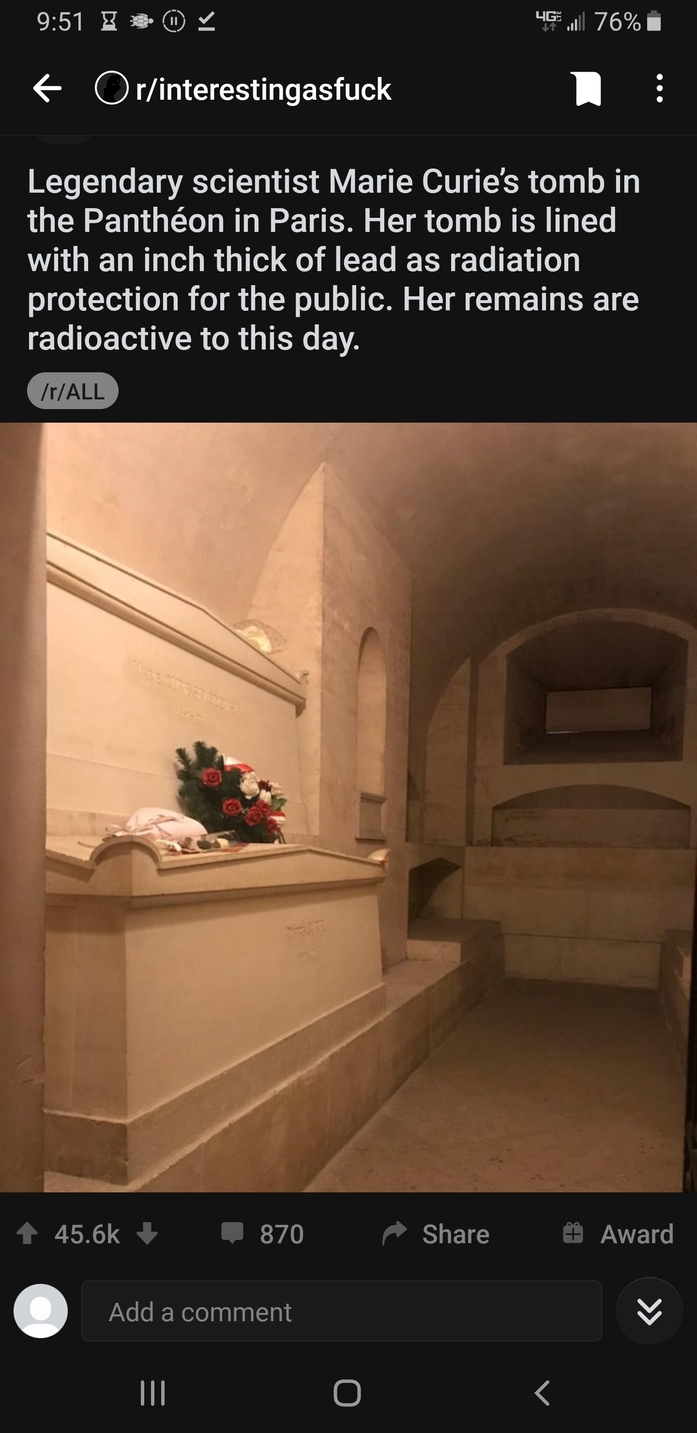
Found this interesting photo with information on Marie Curies tomb
Yeah I didn’t know she was radioactive
That last page from the spacesuit section is a doozy…
Tranlsation for pgs 175 + 176
175:
In this manner, the spacesuit, in order to be active in outer space a long time, various ingenious solutions have been made.
そのため、宇宙服の おもさは、百キログラムを こえます。
For that reason, the spacesuits weight exceeds 100kg.
地上では とても 動けませんが、宇宙では 重さを 感じないため、ただ 動きにくいだけなのです。
Above ground, you simply cannot move but in outer space the weight isn’t felt, enough that you can move.
176:
宇宙には、数えきれないほどの、たくさんの 星が あります。
In space, there are countlessly many planets.
わたしたちが すんでいる 地球も、 宇宙の 中の 星の ひとつです。
We’re living on earth, just one planet in the universe.
では、人間が 住む 地球のように、宇宙人が 住んでいる 星は、ほかにも あるのでしょうか。
Then, if humans live on earth, then could aliens be living on another planet?
p. 177
First, let’s look at the stars (planets) that orbit the sun, just like Earth.
水星や金星は、太陽の熱で温度がとても高く、酸素や水もないため、人は住めません。
Mercury and Venus, which the heat of the sun makes very hot, have no oxygen and no water, so that humans cannot live there.
火星の表面には川の跡や洪水の跡とがあり、昔は水があったのではないかと言われています。
On the surface of Mars there are traces of rivers and floods, and it is said that there might have been water long ago.
でも、マイナス五十度という寒さで、酸素はほとんどありません。
But there is a low temperature of -50°, and hardly any oxygen.
地球からロケットで探査機を送って調べたときにも、生き物は見つかりませんでした。
When space probes, sent from Earth by rockets, examined (Mars), no living thing was found.
Cathm2
July 3, 2020, 2:14pm
154
P177
はじめに、地球と 同じように、太陽の まわりを 回っている 星 (わく星) を 見てみましょう。
First of all, let’s look at the planets which orbit the same sun as the Earth.
Here わく星 seems to specify a planet rather than a star?
水星や 金星は、太陽の 熱で 温度が とても 高く、さんそや 水も ないため、人は すめません。
Mercury and Venus, with a very high temperature from the heat of the sun, since there is no oxygen or water, people cannot live there.
火星は むかし 火星人が すんでいると 考えられた ことがえ ありました。
Long ago it was thought that Martians lived on Mars.
I notice there’s a different sentence in the new version!
でも、マイナス五十度と いう さむさで、空気も ありません。
But, it is said to be minus fifty degrees cold, and there is also no atmosphere.
地球から ロケットで たんさきを おくって しらべた ときにも、生き物は 見つかりませんでした。
When a space probe was sent from earth in a rocket to investigate, living things were not found.
Yeah, 惑星 always means “planet”.
星 on its own can be either, though, just to be confusing. Hence the clarification.
177:
First of all, let’s see if there are earth-like planets that revolve around the sun…
水星や 金星は、太陽の 熱で 温度が とても 高く、さんそや 水も ないため、人は すめません。
Mercury and Venus, with very high temperatures from the sun’s heat, have neither oxygen or water, so human’s cannot live there.
火星は 昔 火星人が 住んでいると 考えられた ことが ありました。
Mars was formerly thought to have Martians residing.
でも、マイナス五十度と いう 寒さで、空気も ありません。
But, with colds said to be -50ºC, it has no atmosphere.
地球から ロケットで たんさきを 送って調べた 時にも、生き物は 見つかりませんでした。
Also, when probes have been sent to investigate by rockets from Earch, no life has been discovered.
Micki
July 4, 2020, 8:08am
157
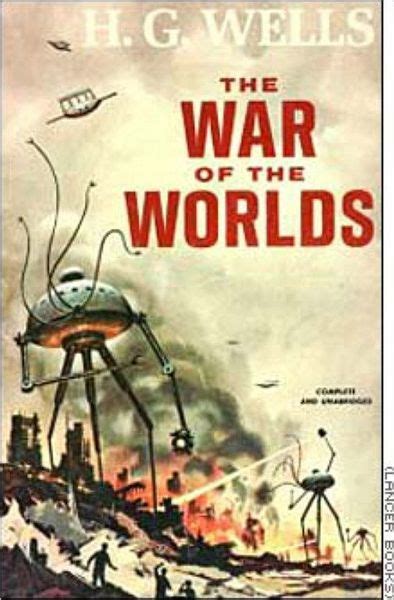
What a sentence! Conjures up the idea that back in the days that we believed the sun revolves around the earth, and that the earth was flat, there was also a widely held belief that there were Martian men on the surface of Mars!
My first thought was that they were referring to this:
But I wonder if they are referring to the idea in the 1800s that people could see “canals” on Mars as evidence of intelligent life?
By the way @IgorTheGreat I loved the fact about Marie Curie’s lead lines coffin. This will be going in my next pub quiz!
Cathm2
July 4, 2020, 12:59pm
158
P178
木星や 土星など のこりの わく星は、ガスで できているので、人が すめる ような 地面が ありません。
Because the remaining planets such as Jupiter and Saturn are made of gas, people can’t live on such surfaces.
それでは、太陽から 遠く はなれた 星は どうでしょう。
Well then, how about planets (separated) far from the sun?
とくべつな ぼうえんきょうで かんそくしたりして、いろいろな ちょうさが されています。
With a special telescope observations, and various investigations can be done.
でも、さんそや 水が あって、あつすぎたり さむすぎたりしない、生き物が 生きていけそうな 星は、今のところ、見つかっていません。
But, having oxygen and water, not having excess heat and cold, planets that seem as if living things can live on them, have not been found.
Cathm2
July 4, 2020, 1:00pm
159
I visited a second hand Japanese bookshop in Sydney yesterday - bought 3 of the series! 3rd grader science one, one biography one, and one other (fairy tales?).
There’s a secondhand Japanese bookshop in Sydney? Where?