Seems fine to me 
2 Likes
I was making good progress, but then it all bogged down again. Doesn’t help I became somewhat sick this week.
Friend linked me to some animes and I admit I got… distracted, though I usually don’t do multimedia. Not because of the story, but because the more I watched the more I recognized words, phrases and snippets, which was really mesmerizing. Also just to hear how and when things like おはよう or いってきます/いってらっしゃい are being used was very educative. But not really what I wanted to focus on right now. 
Most fondly I remember observing how やっぱり was also used as an exclamation under stress, when the character ran into yet more zombies she was like “of course they are coming from here as well.”
Now I go with @ChristopherFritz 's advice and try to have a speechbubble a day and be content with my self if I got as far as preparing all the tabs and opening the books. But it makes me wonder: Why is it so hard?
What came under suspicion is that every now and then, I learned something new. How to mind-read omitted sentences, how to process +くれる and から and so many more things, all of which my memory tries to recall the moment I sit down to read.
Fact is, I can’t recall it all just like that. So today I browsed the other threads and notifications to copy-paste together what advice I could find from past questions I had, but that’s patchwork, and I still have to leave through the manga and my browser’s history and bookmarks in order to recollect what I’ve learned outside the WK boards.
While writing this, I consider creating a Japanese Learning journal for myself, about what I learned instead, probably like a study log or something. (This kind of method comes to me naturally, but FYI: at it’s foundation it is about clearing ones mind and unburdening the memory, in order to free up head space for new stuff. Scholars of every epoch did it, seems a reliable thing…)
Anyway, I have to tip the hat and accept defeat. I really want to just open up the manga and keep reading, but my own mind doesn’t play along anymore and I’d be a moron to fight it trying to recall what I’ve learned previously.
So anyway, I’ll work on this reading journal and continue catching up as soon as I regained the mental space to work with. :fox:
6 Likes
Neither could I.
Your experience is typical and nothing to worry about.
When I went through my first full read-through of a manga volume, I wrote blog posts[1] of all the new things I encountered, which I figured would help me learn and remember them better.
For me, it didn’t help.
I’d encounter some brand new grammar I’d never seen before, I’d look it up online, and all the search result links would be purple because I’d already clicked on them previously. And I’d later find I already did a write-up on that grammar, yet I still didn’t remember having encountered it before.
Anything you can do that helps you retain the grammar you’ve learned is good, but if nothing works, just keep going.
Each time you encounter grammar you don’t recognize, learn it.
Even if you learned it already and forgot it.
Over time, after learning some of that same grammar over and over from scratch, pattern recognition will start to kick in. You’ll have seen the grammar used in various contexts and had refreshers of what it means a few times along the way.
Ask questions in the weekly threads, even if it’s material you feel was covered in a prior week.
Any time I answer a question and say, “Here is where we’ve seen it earlier in the manga,” it’s not to say you should already know it. Rather, it’s to give extra context with scenes you may recall to help build up the patterns in your brain so you may be more prepared to recognize them eventually.
You’ll want to move forward with what works best for you.
If you’re unsure what will and will not work for you, I recommend maintaining the status quo at least through the end of the volume (and through the second volume if you want to continue the series).
If you can push forward with reading alongside the club, even if it means asking about previously-covered items, you will build up that necessary pattern recognition for at least some of the most common grammar.
By the way, on my first manga read-through, some grammar took me months to recognize and remember.
[1] That’s why on most of my website’s Japanese examples are from one manga volume, as I converted my blog posts into what I have there
6 Likes
Do it 
Those reflections are a big part of learning, there are so many ways to approach learning Japanese. And even if you try very hard, I believe there are a lot of things that need to be processed in the background before they can be assimilated = it just takes time. A bit everyday is the best way to keep moving forward.
A study log is great to be able to look back at how much you’ve learned, spark discussions and get advice and so on
Haha I know that too. “Oh interesting word, never seen it before, I wonder if I’ll encounter it on WK”, * check WK, I have already burned the word *
5 Likes
Only months? I’m pretty sure stuff like potential and passive are only vague ideas in my head and I can only understand the material I’m reading, because of context.
Not knowing grammar points is normal, at the beginning you are pretty much training your brain to recognize meaning from the context you understand, and then work backwards from that to arrive at a meaning for the individual parts making the sentence up, and only after quite a bit of immersion will you actually understand those individual parts on their own. The brain is a magical device, that can teach you a language perfectly, even if you only feed it low quality input at first.
6 Likes
p. 54
バッチリ
I just want to drop this link to Japanese stack exchange because I was interested in the origin of the word and found this here reply very enlightening and to the point.
In a nutshell, it is onomatopoetic language, and
That it is save to assume words like バッチリ are something purely Japanese culture in the spoken, living language. 
Also: Yay, decided to have a small peek to redeem my failing to get any reading done today, and turned out that I was able to read pp 53 and 54 with only two necessary look-ups, this one included. (うさぎさん I was able to precision-guess by context.)
4 Likes
Made it through this section!

This was the sentence that gave me the most trouble. Had to actually sit down and figure it out on paper by breaking down all the parts.
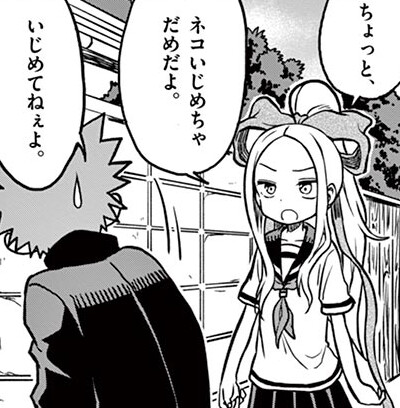
Also, am I right in noticing that in the -teiru forms a lot of times the ‘i’ is omitted in dialogue?
5 Likes
Yes. This is extremely common in manga, where dialogue is written how it’s spoken. (And it took me a little longer than it probably should have to grasp/recognize when I first started reading…)
4 Likes
Thanks! I noticed this the other day when I was reading straycatj posts on tumblr:

Then promptly forgot again, got confused at what してない in the above panel could possibly mean, then remembered again.
3 Likes
after that comes the る column to ん slurring (何してるの → 何してんの?) and the ない to ねえ slurring (してない → してねえ). All of these are very common if you read more shonen/young adult manga
4 Likes



It comes up often in 「よつばと!」, as well, from Yotsuba’s father.
4 Likes
