I see it as a day to recover from the celebrations of the eve, so my mind screams “no working” 
1 Like
Don’t you dare!
1 Like
You are supposed to burn them, not push them around!
or was that only, Turtles… 

1 Like
That’s Koichi, A-Regular-Durtle, and ? in the last puzzle helping us get to the goal line. 
Bet you any money his favourite turtle is Venus de Milo.
1 Like
Should we summon?
Oh holy @koichi, will you honor us with your presence and knowledge?
For we have pondered and spoken, till 3500 comments have been reached

I found this by search “Turtle Magic Gif”
I guess it could pass as a turtle without a shell? 
5 Likes
omg he did it
1 Like
I was learning Zhuyin input on NYE, for crabigator’s sake. (To be fair, it was easy and I already got the concept. But I couldn’t stop thinking about it until I tried it).
3 Likes
How many input methods does that make? 6 in this thread? 

I guess he wasn’t actively watching at the moment at least…
If I go to bed he will probably appear
And there are no crickets chirping… they all died =/
Twice now I’ve failed to make a colony…
But the Dubia roaches are doing great! <3
1 Like
I need to go too, I was hoping that we was lurking around here
1 Like
Oh well, in that case…
*Gets out the chloroform*
2 Likes
Whoa, I can’t believe this puzzle has lasted all the way into the year bc4年! Nor that this thread has over 1700件! And yet, the numbers speak a clear language, so it must be so, and that means I want to learn 17 kanji in this thread!
Since it’s the start of a new year, and there is much talk of time and calendars, perhaps we should learn some kanji related to this special time. In Japan, the first three days of the year are known as 正月三が日 (or just 三が日 for short), and are considered a time to set the trend for the rest of the year.
If you’ve cleared WaniKani level 1, you’ve already encountered the kanji 初 (first), along with its readings しょ and はじ. However, you might not have learned the reading はつ, which is commonly used when describing the first occurrence of something in a new year. Let’s learn some kanji which we can use together with this reading.
You’ll notice that even in compounds, 初 the kanji that follows it usually keep their kun’yomi readings. That’s because the followers of Hatsu have lots of gaman (perseverance; grit).
Who is Hatsu? Let’s find out!
---------
Kanji 14
詣Kun’yomi: もう(で)
On’yomi: けい
Meaning: reach, arrive; attain (a skill); visit (esp. a shrine/grave)
Etymology: Phonosemantic compound - Semantic 言 (talk, say) + Phonetic 旨 [Source: YellowBridge]
I’m not quite sure how the semantic component 言 here pertains to the meaning. I suspect that the initial meaning was “visit” or “have an audience with”, which then became “reach” or “arrive”, which then became “attain”. That’s just my speculation, though.
One source suggests that the character is an ideogrammatic compound, with 言 (“talk”) + 旨 (“delicious”) conveying the idea of sweet-talking a superior to attain a higher standing. I’m taking this with a spoonful of salt, but it does make for an interesting mnemonic.
HatsuWaniKani: It’s the start of a new year, and you’ve decided to start eating healthy.
Your friend (whose name is Kayleigh, but you just call her K) has recently introduced you to kale (けい). It took a while to get used to, but now you’re addicted to it.
Lately, you won’t stop talking (言) about how delicious (旨) kale is. Why, it’s so delicious, you eat kale with a spoon!

You call (言) kale “a spoonful (⼔) of sunshine (⽇)” because it always brightens up your day.
Vocabulary:
-
初詣 (はつもうで)
hatsumōde; first shrine visit of the year
You begin to worship Hatsu, a kale spirit. On the first day of the year, you go do do hatsumōde at Hatsu’s shrine.
Well there, you take out your spoon and your bowl of kale and begin to say a prayer.
You ask Hatsu how you can afford to keep up your kale-rich diet, and to your great shock, Hatsu responds.
Thus spoke Hatsu: “Mow the lawn! Kale is basically just glorified grass.”
Why did Hatsu grace you with her wisdom? Perhaps because you said sweet things (言+旨) about Hatsu in you prayer, and it got Hatsu into a talkative mode.
-
造詣 (ぞうけい)
deep insight; profound knowledge
Now that you have received this deep insight into the true nature of kale, you head down to Kmart to buy a lawn mower. It’s the Kmart where your friend Kayleigh works; that’s why you call her “K”.
Sometimes you call her ZoU K (ぞうけい), because she studies at Zombie University and works at Kmart. Oh yeah, Kayleigh’s a zombie; did I forget to mention that? Sorry; eating kale has made me so woke, I no longer see undeath.

Zombie woman picture by Anton Brand, other pictures via … Google, I guess. http://www.antonbrand.co.uk/home/4593429029
Anyhow, ZoU K asks you what you need the lawn mower for, and you tell her about your profound knowledge. She is impressed with your intellect, and says you must have a very good brain.
You’re not sure why, but this makes you feel uncomfortable, so you leave.
---------
Kanji 15
釜
Kun’yomi: かま
On’yomi: ふ
Meaning: kettle; cauldron; iron pot
Etymology: Phonosemantic compound - Semantic 金 (gold; metal) + Phonetic 父 [Source: YellowBridge]
Note how the “hat” (𠆢) on top of 金 is not present in 釜; it’s as if it has melded with the cross in 父 (perhaps because the pot got so hot, it melted)?
Kanji Portraits suggests the upper component may in fact be a hand holding something, rather than a father.
Note on readings: 釜 has the same on’yomi ふ as 父 (ふ), which helps us remember that 父 is the phonetic component.
釜 shares the kun’yomi かま with 窯 (stove, furnace, kiln) and 缶/罐 (pot; can; boiler), and is similar to the かまど reading for 竈 (hearth, kitchen stove). It’s likely that these are cognates, derived from the same word in some older form of Japanese.
WaniKama: It’s the start of the year, and you’re waiting for your otoshidama.
Winter bonuses have just gone out, and you’re certain that your dad (父) is sitting on a pile of money (金). It’s a pile of money so big, it seems to have no upper upper bound.
Your 父 sits on 金 without 𠆢 = 釜.
You ask him to give you a pot of gold, but he just gives you a kettle.
You say “Come on (かま), dad; gimme some more!”, but he just says “F U.”

Vocabulary:
-
茶釜
chagama - a Japanese tea kettle
This word consists of 茶 (tea) and 釜 (kettle), with the kun’yomi reading かま rendaku’d to がま.
Notice how the kun’yomi survived being placed into a jukugo (kanji compound). That’s because it’s a Japanese tea kettle, with lots of gaman.
-
初釜 (はつがま)
first tea ceremony of the year
TL;DR: 初 (はつ) + 釜 (がま) [rendaku’d かま]
TL;RA: You are very disappointed with the gift your dad gave you. That’s because you’re a spoiled brat.
Therefore, you worship Hatsu (はつ), the goddess of spoiled brats. That’s right, Hatsu is the goddess of both kale and spoiled brats, as well as Pizza Huts and people who have the hots for their local weather forecasters.
These more esoteric kami have to cover a lot of ground in order to draw worshippers.
Anyhow, you’re a lazy brat, so you decide to get your hatsugama and your hatsumōde done in one go.
So, you take your chagama and head down to Hatsu Hut. You prepare the tea ceremony and pray to Hatsu for understanding.
Thus spoke Hatsu: “Gaman, my child. Your father wishes for you to learn gaman.”
You’re glad you had your first tea ceremony of the year with Hatsu. You get the idea for a new brand of tea called Hatsu Gaman, a seasonal tea that should only be used for hatsugama. You will show your dad that you can make money on your own.
-
釜中の魚 (ふつちゅうのうお)
fish in a pot about to be boiled; person blissfully unaware of danger
This seems to be a pretty obscure term, but it is an interesting one. I did find some examples of 釜中 online, though.
Francis Urquhart has just put a fish (魚) in (中) a kettle (釜). The fish obviously isn’t happy about this, so it says “F U!”.
Francis isn’t perturbed; he just says “F U, too.” (ふちゅう) to the fish.
He doesn’t notice that there is a water ooze sneaking up behind him. When he sees that, he will no doubt say things like “No!” (の) and “Whoa!” (うお)
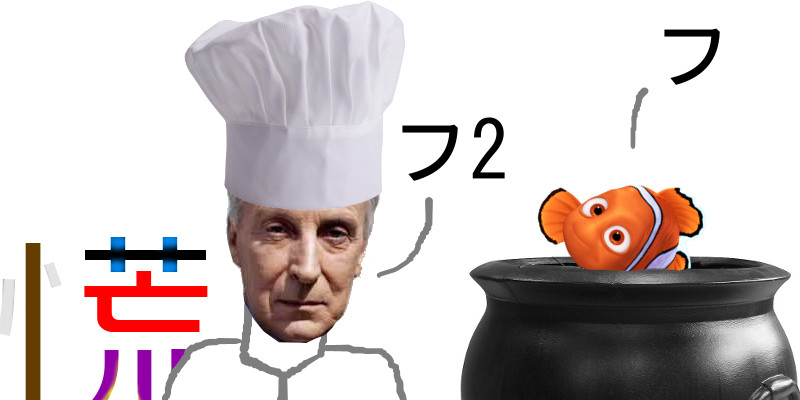
It seems that Francis was the real 釜中の魚 in this scenario.
4 Likes
I’m about to go in coma without any drugs
Such tiereds!
:durtle_sleepy: :sleepydurtle: Nope… we could need one  We often do remark going to bed or being tiered, so I can see it being used in comments =)
:durtle_coma:, sounds pleasant!
OK, going to bed! Lets see how long it takes from when I leave till he shows up!
A wizard @koichi is never late, nor is he early, he arrives precisely when he means to
3 Likes
Hehe, thanks; I’m having fun. And thanks to all of you who are actually still working on the puzzle 
Mac ‘N’ Durtle with Bacon and Cheese
1 Like
Durtleの米は世界一

3 Likes
YOUR OVERLORD DEMANDS THAT Y’ALL SHOW RESULTS!

Worked last time. Don’t fail me.
3 Likes
Hey, you all decided to get help on the last one in exchange for no help on this one 
Also, I just wanted to express my appreciation for all the people who seem to think I know any math at all. It’s very nice of you, but I went to public school in the USA so…
17 Likes
Hey, I went to public school in the U.S. and I still know the maths.
3 Likes