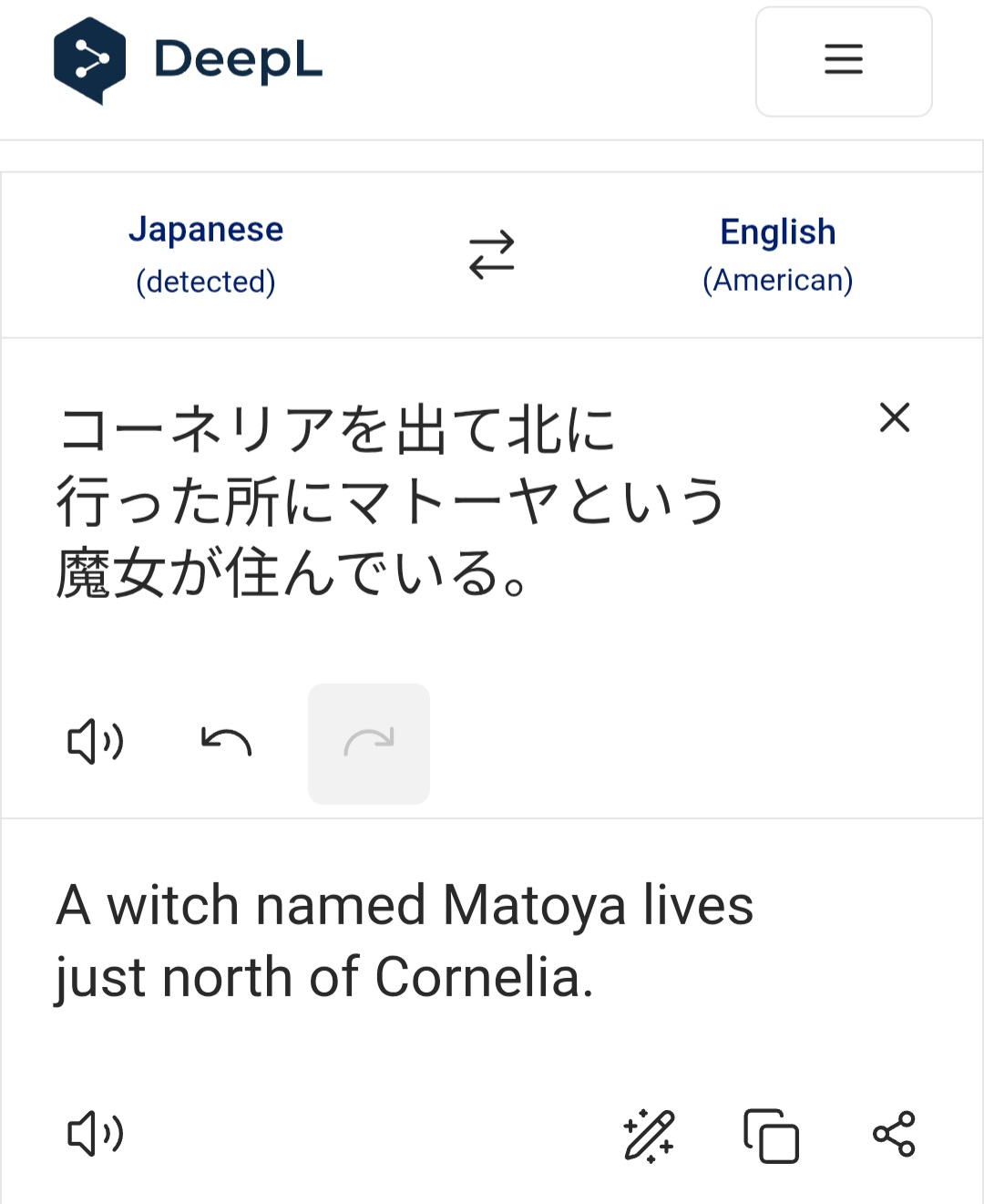
This grammar is way beyond what I’ve studied. This is the best translation I can come up with. It still doesn’t equal what Deep Translate says. I think the kanji for “place” is throwing me, like do I have to include it in the translation, or is it just assumed?
Sorry, I’ll try to keep it to one question a day at most. Thank you
I’m certainly not a grammar expert, but I don’t particularly like the DeepL response, because it seems to me that it is omitting useful context regarding actions or movement that the speaker had taken, and instead is just presenting an observation based on the results of those actions.
Thank you. I usually just try and translate it, then check it against Deep Translate if I’m unsure. I’ll study more grammar today, but I still won’t be up to the level of understanding everything by fall.
Yeah deepl simplifies the sentence somewhat, probably because it doesn’t understand that it’s in a videogame context and tries to make it sound more natural in English. It’s true that “There’s a place if you go north of Cornelia where a witch called Matoya lives” is a bit clumsy if you’re just giving random instructions IRL, but in-game the fact that you can physically go there (presumably by walking) is actually important info, because a lot of the in-game locations are unreachable from the start!
Contrast this with a line much later (not really a spoiler):
南には、鷹の翼と呼ばれる古い町があります。
In the south, there’s an ancient town called “Hawk Wing”
It doesn’t say anything about how to get there and, indeed, it’s a bigger ordeal than merely walking southward given that there’s a mountain range in the way…
I don’t think that 北に行った所に implies that the speaker specifically has been to that location themselves. It’s the location that you/one/anybody is in if they have left here and gone north.
I have not viewed the original quoted text in situ - I’m guessing that it may have been taken from a narration rather than from a known individual who had spoken it.
But still it would seem that at the very least the DeepL translation misses some of the original context, and instead substitutes a stripped-down, overly-simplified interpretation of the statement.
There are many ways in which the “just the facts” approach given by DeepL could have been stated in the original text, but that’s not what was actually presented in that original text.
I’m in a Japan Travel Tips group on Facebook, and you would not believe just how many times I’ve had use almost this exact line on people going “why’s there no direct train between Fujikawaguchiko and Kyoto?” Or vice versa. Especially because they’re visiting Fujikawaguchiko specifically because of the mountain that’s in the way.
Can you ask DeepL to use less “smoothing” ? It may help
Like this is my GPT translation prompt:
“Japanese proposition order preserved exactly, with each proposition rendered meaningfully in clear English without reordering, but no smoothing across the whole sentence.”
The sentences are less pretty but context is never ignored and the neutrality of pronouns is preserved.
I feel like the answer there is more “Fujikawaguchiko just isn’t big enough to be worth it”, though? The nature of a railway network is that most places don’t have direct trains between them. Conversely there is a direct train between Kyoto and Tokyo even though the straight line between the two cities would go through various mountains: the direct train simply doesn’t take the straight line route.
If it’s your first steps an even better structured prompt (a prompt is what your ask the GPT model) could be something like
"I am learning Japanese, and need to get translations to understand better.
I will paste sentences in Japanese and you will respond with a literal translation.
For the translation:
The Japanese proposition order must preserved exactly, with each proposition rendered meaningfully in clear English without reordering.
I do not need a pretty translation and especially no localization but one that helps me with understanding the underlying language structure, no smoothing toward English.
Please respect the language neutrality and do not assign genders to pronouns unless the context is explicit.”
you should be able to make it vary following your preference over time




 I’m impatient. Maybe I should switch to something else for a while.