I technically reached level 60 two months ago but I had accumulated a backlog of vocab lessons from rushing the last 10 levels that I finally completed this week:

I started WaniKani in November of 2022, so it took me roughly a year and half to cover all the material. I’m in my late 30s so it feels a bit strange to think that within the span of two years I went from seeing kanji as inscrutable moon runes to being able to derive meaning from them. In some ways my life hasn’t changed much over those two years, but a whole new world is now within reach!
Do note that I’m a freelancer who works from home, so it’s easy for me to find time throughout the day to do my reviews and on top of that I’ve used similar SRS systems to study Portuguese and Russian in the past so I knew what I was getting into and I knew what I was getting into and how to use these tools efficiently. I don’t think my pace is necessarily reasonable for people whose lifestyle is not as permissive as mine.
I want to thank the script writers for allowing me to work around some of the limitations of the website (WaniKani would be near-unusable for me without undo). In particular I extend my deepest gratitude to @Joeni for continuing the legacy of Flaming Durtles, it was my main WaniKani interface and improved the experience massively for me. I also highly recommend the keisei script, the more kanji you know the more useful it becomes.
With the benefit of hindsight I can also answer some of the questions and doubts I had when I started:
How good are you at Japanese once you’re at level 60?
Knowing kanji is obviously a massive help when reading Japanese. Kanji are a huge hurdle when you start learning Japanese and it gets in the way of everything else, but once you reach a critical mass of about a thousand kanji (around level 30) it sort of flips around: kanji make reading easier. You can derive a lot of meaning from just recognizing the kanji in a sentence. It makes dealing with new vocab a lot easier too, as long as it’s spelled with kanji you already know.
It also makes it a lot easier to deal with new kanji since the vast majority of the time they’ll be made up of radicals you already know. I learned 鎧 fairly effortlessly a couple of days ago even though it’s a 18-stroke character, but obviously it’s just 金 + 山 + 豆 so if you know these blocks it becomes trivial to recognize and memorize.
That being said WaniKani alone won’t let you read Japanese. You’ll need to study grammar, important kana vocabulary and then get used to using all of that in the wild. If you just do WaniKani alone you won’t be able to read even the simplest Japanese text by the time you’re done.
What worked for me
-
First of all I want to say that in my opinion, when it comes to bootstrapping language knowledge, quantity beats quality. Don’t feel bad for abusing undo if you feel like you were “close enough” or even passing outright failed reviews if you feel like you may remember it later. Knowing 2000 kanji okay-ish beats knowing 1000 kanji super well when it comes to practically reading Japanese.
-
For the first 15 to 20 levels I mostly did just WaniKani. I did also listen to a bunch of Cure Dolly’s videos but at that point I would recommend just getting a feel for the grammar, not focus heavily on any particular topic. I remember rewatching some of these videos a few times over the course of a year or so and getting more out of them every time as I had more experience with the language.
I would recommend going as fast as possible through these first levels because those kanji are extremely common and you’ll see them everywhere all the time. You get a massive return over time invested. This kanji coverage chart is always worth keeping in mind:

You can see that at around level 20 you get about 75% kanji coverage in the wild. The more kanji you know the more you understand, obviously, but it also makes it easier to focus on the remaining unknown ones and increases the chance that you’ll learn them organically. There are a bunch of kanji I learned just through exposure that way because they came back so often in all sorts of materials.
- The road to level 30
As I got closer to level 30 I noticed that, when I tried to read some simple Japanese (like easy manga or videogames), while I still needed to look kanji up regularly, it was no longer the main issue. I was mostly struggling with grammar and vocab.
At this point I started using bunpro seriously. I tried learning two grammar points every day which covers all of N5 in about two months, and N5-N4-N3 in about 9 months. N3 is the target you should aim for in order to engage with early-intermediate Japanese content. Note that I mainly used the grammar part of the website, they also have vocab decks but I can’t vouch for those.
I also used this JLAB anki deck which gives you some simple N+1 practice using snippets from real Japanese shows. It’s a good way to get used to reading actual Japanese (don’t forget to edit the card model to remove the roumaji and only keep the kanji, there are instructions on how to do that in the deck’s description).

- The part of WaniKani that doesn’t work so well: 30+
At this point you should really think about spending more and more time actually reading Japanese and working on other aspects of the language instead of spending hours doing SRS drills. That’s why I say that this part of WaniKani becomes frustrating: on one hand there are plenty of kanji in there that you’ll want to learn, but because you can’t decide which one to study due to the level structure you end up having to memorize words and kanji you don’t have an immediate use for while a kanji that you do want to learn for something you’re reading at the moment is locked 15 levels away.
The higher I got into the levels the more frustrating it became. That’s why you can see in my level up chart above that I first slowed down significantly at level 40, then decided to rush the last 10 levels to get it over with.
- Just read
Just read. It’s always going to be messy and super difficult at first, it’s one thing to be able to answer SRS questions in a controlled environment, it’s an other to use that knowledge it in the wild. Many times at first you’ll fail to recognize a word or kanji that you saw many times on WaniKani. That’s perfectly normal. You need to build your reading skill and your confidence. Set your expectations low and painfully work your way through simple material (ideally material you already know at first), and eventually it gets easier.
- Bonus: kanji drawing practice
I can’t really recommend doing that because it’s a huge time investment but around level 15 I decided to start learning to draw the kanji using this Anki deck:
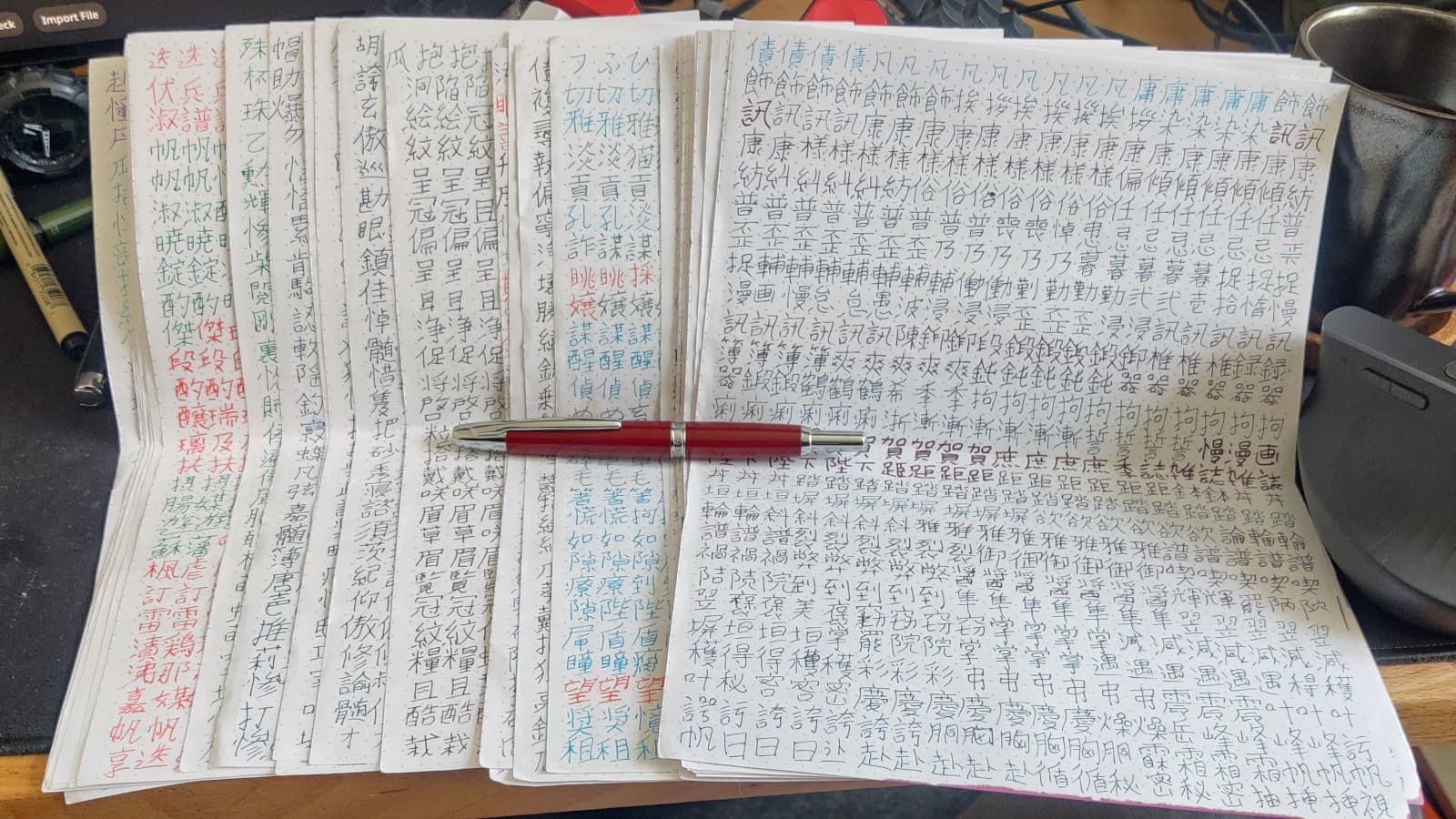
I don’t regret doing it but it takes a lot of time and it’s of dubious value if you don’t intend to actually handwrite Japanese. Since I would typically write every kanji a bunch of time for every review, I wrote well over 100k characters in the span of a year and I would spend 30m to one hour just doing these reviews on top of everything else:

Are there enough kanji on WaniKani? It doesn’t even cover the Jouyou!
I remember being a bit bummed out when starting and I noticed that WaniKani didn’t cover 100% of the Jouyou or those JLPT kanji lists you see everywhere. All that work ahead of me and that won’t even be enough! I think this is a common frustration since we routinely see people in these forums ask for more levels in order to cover the Jouyou/JLPT lists.
So is it really a problem? I would say no. In fact I would argue that there’s too much stuff on WaniKani. It’s not to say that the kanji you learn aren’t useful, it’s that at some point you’ll want to move away from WaniKani and towards learning things more organically, and for me that point occurred long before I reached level 60 as I pointed out above. I would have preferred if WaniKani had 50 or so levels (like it used to) but packed with the most useful kanji and vocab, leaving things like kanji used mostly in names outside of the course or on a different track.
On top of that since I’ve completed WaniKani I started adding extra kanji to my Anki deck, and while some of them are Jouyou, many aren’t. Some examples from my latest additions:
-
錆 (rust): not Jouyou but I encounter it regularly
-
鎧 (armor): not Jouyou but very common in videogames obviously
-
醒 (awake): Jouyou, reasonably common in my experience although 目覚める is an even more common way to talk about 覚醒.
-
貰 (receive): not Jouyou but sometimes used to spell もらう in more formal settings.
-
傭 (employ): not Jouyou, used to spell 傭兵 (mercenary) which is reasonably common in the games I play.
On this last one note that if you encountered the word 傭兵 after finishing wanikani you wouldn’t be able to know what 傭 means, but you would know the 兵 kanji (taught on level 17) and that it means soldier. So in context you can still make an educated guess as to what the word means, and you’d be very likely to remember the word if you encountered it again a little while later.
I think the average native Japanese speaker can recognize about 3000 kanji, so obviously WaniKani will not cover everything, but it teaches more than enough kanji to bootstrap the process and give you tools to deal with the rest. That’s the important part.
Was it worth it?
Yes. Overall I could spend a lot of time criticizing WaniKani and some its design decisions but for all its flaws I genuinely think that it pushed me to learn more in a shorter amount of time than other kanji-learning systems. While I did find that the unlock/level system was frustrating in the 2nd half of the course, it was hugely motivating early on. It gives you a short term objective, a measure of your progress and clear goalposts.
Conclusion
Do your reviews. Keep pushing. There are good days, there are bad days, but as long as you don’t stop you’ll reach your target eventually.
I first very briefly tried to learn Japanese 20 years ago when I was in college, I gave up because it felt like I wasn’t progressing fast enough. If I had continued, even at a slow pace, I’d be fully fluent by now. The idea that it will take you 5+ years to finish WaniKani if you’re not going as fast as I did may be demotivating, but if like me you give up then in 20 years you’ll think “wow if I had kept up I’d be so far now”.
I learned from my mistake and you should too. Slow and steady wins the race.

