If you’re still stuck I’d recommend reading the rest of chapter one with your English copy and starting fresh with chapter two. There’s no dialect in chapter two, so hopefully that will help you progress more smoothly.
4 Likes
That would feel like cheating 
I’ll just take my time for now… maybe I can try to catch up here this week … my sensei is back so that might be the saving grace for me… anyway at least I made it to page 26… only 3 left to go…
NAIL ON THE HEAD!!!
1 Like
This book is far above my level, but I’m trying to translate one page per weekend, picking up new vocab which I would not find in WaniKani (recent example のろのろ slowly), new links to grammar tools etc. Also following this thread gives me the feeling of community, and encourages me to try. Also I hate quitting in general.
Of course, one should be able to get out of upsetting situations. I guess my point is that you may change your load from full effort to partial, and still get some benefits. I feel like you are the most active participant on this thread so far.
6 Likes
I figured this out but ugh… only because I had the English version… when you get to Page 27
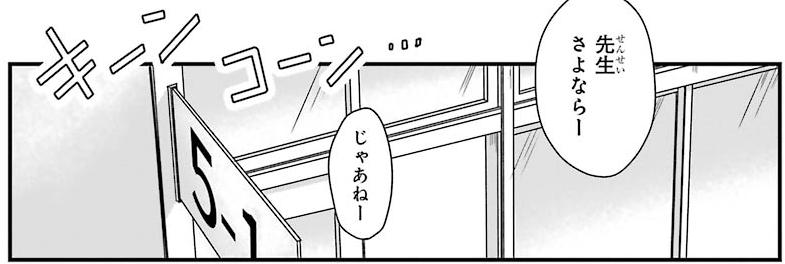
part of the line - コーンと音をたてている
コーン is NOT Corn
katakana does me in yet again
 I’m sitting here trying to figure out what corn sounds like as in corn fields…Imagining the wind blowing throw the corn fields …[the scene is set in my mind and wind is blowing the umbrella right] (maybe because my grandfather and a family friend grew corn when I was a kid… so I’m probably the only idiot that would think of this)
I’m thinking in English it’s more like click click or clip / clop - but that’s more horse sounding… Hope this helps someone 
3 Likes
It helps if you imagine it in proper quotes. 
コーンと音 → 「コーン」と音 → the sound “コーン”
3 Likes
Although it’s totally not the same sound, I feel like this is exactly why everyone needs a proper amount of school manga in their reading =)

3 Likes
good idea… definitely going to remember this little trick…
to be fair… this is only the 3rd book I’ve tried to read cover to cover… I just thought for sure someone else will run into the same thing …I know I’m slow, but I am certain there are others slower than me
2 Likes
Hey all - Read Aloud session starts in 15 minutes! See you in Discord
3 Likes
Finished this chapter, ending was surprisingly easy. I entered the new vocabulary in the spreadsheet, but since I’m reading on kindle, I don’t know the page numbers. Order of appearance is correct.
Btw how do you guys go about memorizing the vocabulary? Do you add everything to srs program or don’t bother? Between books I’m now reading and vocabulary from textbooks, personally, I can’t keep up with so many new words. 
3 Likes
If I’m interested in the word I put it in Anki but I don’t do that for every word.
2 Likes
finished tonight finally… with no more questions on chapter 1… now if only I can catch up with Chapter 2
3 Likes
Finally finished my second “deep” read-through of the chapter and I still have a lot of questions. For starters:
かさをかばんの取っ手にはさんで、ずり落ちないように気をつけながら、神社のわきのゆるい坂をのぼっていた。
Confused about this. Does the first phrase mean something like Rena gripped with bag handle and the umbrella ??
Forgetting where this one was located, so we’ll see if anyone can help: としか書いてない
And…
草の青くさいにおいが、鼻についた。
Literally: There was a grassy smell of noses?? Her nose caught a grassy smell?
Thanks!
2 Likes
I’ve found that SRS systems are a trap. The temptation is to build an enormous deck with hundreds or thousands of cards. But it’s easy to end up effectively trying to memorize the dictionary, you’ll never be able to keep up with all the reviews, and as soon as you fall badly behind you are very likely to give up. (Been there, done that. Repeatedly.) Besides, memorization isn’t how you learned your first language.
So my current strategy is to capture no more than five words from any reading or vocabulary-building session. And to allow no more than 25 words in a deck. For the rest, if I need to I’ll look it up again when I encounter it again, and eventually it will stick.
かさを - umbrella (direct object)
かばんの取っ手に - bag handle (indirect object)
はさんで - て-form of 挟む - to put between, to insert
So all together, I interpreted this as She put the umbrella between the bag handles.
Did not search where this is located, but しか means “only” and it is always followed by a negative verb, so it means only writing or something (depending on context). Does this help?
鼻につく means “to get into one’s nose”.
This sentence is a very typical example of Japanese redundancy, I’d say Literally translated it means something like The smell of the grassy-smelling grass got into her nose.
6 Likes
しか (+ない) does mean „only“ or rather „nothing more than“, and I assume context is something written on a sign (judging from the quotation と):
There was written nothing more but „…“
4 Likes
I use FloFlo, but I’m extremely selective about which words I add. My criteria include things like frequency of appearance, how easy I think it’ll be to remember, whether I already know the kanji used, etc.
It’s not only that it’s difficult to keep up with adding dozens of words a day, it’s that it’s not helpful to learn hundreds of words you won’t see again in context any time soon.
6 Likes
I know these are already answered, but sometimes it helps to hear it said more than one way:
“The only thing written (on it) is/was …”
I walked past someone working in a park a few days ago, and experienced this very thing. 
A strong grassy smell filled her nose.
4 Likes
Yes thank you! I think I got confused by the と. I keep forgetting what it does at the beginning of a phrase.
やった、finished chapter 1! Now here are some questions that didn’t prevent me from understanding the story but I’m curious about.
1. Page 20
そのおめさんのかさだっとも。
This だっとも appears in several other sentences as well, and it’s probably just a grammar point that I don’t know yet, but to me that sentence is lacking something (That umbrella of yours… what?), so I’m wondering how you would translate it.
2. Page 24
わたしはなにも、こんなところへきたかったわけじゃないのに、おとうさんがむりによこしたんだもの・・・。
I parsed this as:
こんな・ところ・へ (to such place)
きたかった (want to come)
わけじゃない (it does not mean that)
のに (despite, even though)
So I get something like it does not mean that I want to come to such place, but it makes more sense to say it does not mean that I don’t want to come to such place, so I’m guessing that’s the なにも there. But the comma makes it difficult for my brain to attach it to the next sentence and then make a break at わけじゃない. So which way of understanding it would be correct?
3. Page 28
リナは、あまったるいピンクのドアを見て、そう思った。
Which of the two entries for あまったるい would be more correct here? I’ve seen that the person who added this word to the vocab sheet has a preference for the first one sentimental, mushy, but I personally had chosen the second one before looking at the sheet sugary, saccharine, sickly-sweet.
In Spanish we actually have a color that we call “chewing gum-pink” (rosa chicle), and because here Rina is describing the door of a candy shop (or actually she guesses it from the color of the door), I wondered if the entry related to sugar and sweets could actually fit here in Japanese.
4 Likes
おめでとうございます~! 
Page 20
There was some discussion about とも in the first week, and I think the general consensus was that it was the dialectal version for けど. In this case I interpreted it as filler, or just hinting that there’s more he wants to say on this topic. I might well be wrong!
Page 24
It’s ‘it’s not like I wanted to come to a place like this’, so your first instinct was correct. ^^ なにも coupled with a negative verb (I think it is indeed じゃない and that the comma is simply there to help with the parsing) means something like ‘not at all’- although she didn’t want to come at all, her father send her off anyway.
I noticed you had an extra う in your sentence there - it’s よこした, from 寄越す, to send (forward).
Page 28
I think this may be a matter of preference - the Japanese carries both of those connotations, so why not think of both?
Edit: For what it’s worth, when there’s room for interpretation like this, especially if it’s room for punny or really fitting interpretations, I always err on the side of ‘yep, surely that’s intended.’ ^^ But in this case I think it is simply a concept in Japanese that does not have an exact equivalent in English, in that English separates it into 2. If that makes sense. 
7 Likes