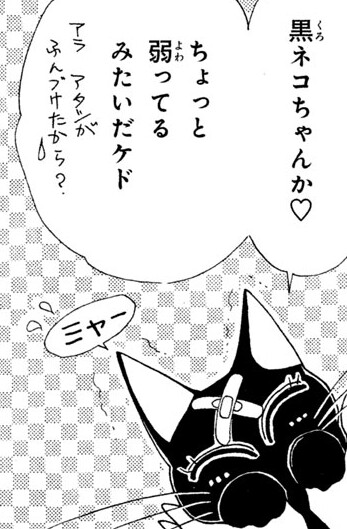
That’s actually the only example I could find.
But you will see わたし (without the kanji) used a lot.
leave it to you to find the 1 example hahaha…  I’m sure I’ve seen it before too but it’s definitely rare… since you found that one how about the other reading 私 (わたくし) challenge you to find that one written in hiragana… (and NOT one from a genki textbook furigana or anything)
I do find it fun how a lot of Japanese people think Katakana and English is cool and Foreigners find Japanese and Kanji cool…Was watching something (forgot what it was though)…but there was a town that was proud they had a train station with a katakana name… so much fun! 
for the record I didn’t doubt you could find them…but I’m totally shocked at how fast you found them!!!
Am I wrong or is it アタシ??
I’m not a manga expert so I don‘t know if this happens in american comics too but it looks like I’m going to see lots of exceptions  I hope takagi-san will be kind to me.
I was studying words from the list you gave me and I know a surprising lot of them, but there are some that concern me.
These are the only things I’m missing in the 100 most common words, can someone clarify?
(I know that some words could mean different things, but knowing the most frequent use will be enough)
いう: is this 言う? Does it happen a lot to see verbs in full hiragana (or even katakana)? I’m thinking that these will be a pain to recognize at the beginning
よい: is this いい?
西 and 方 separately, do they mean anything? Looks like 西 means west
コト: is this the katakana version of こと (abstract ‘thing’)?
つく: what does this mean?
くそ: is this the exclamation?
こっち: ?
It is 言う, yes. It’s fairly common for it to not use the kanji, especially in cases where it is more of a grammar point (like ~という). Some words (and it’s not just limited to verbs) do drop the kanji a lot. 行く is another one that you will often see as いく. This can be confusing sometimes with いう when conjugation gets involved. いっている could be either one, for example. However, context will inform you which is correct. Just takes practice!
It could be, but よい is the more formal version of the word. I am also hard pressed to think of when we have seen it in this series, but it’s been a while since the first volume… This could actually be just a noise similar to よーし or よいしょ, as well, and I think よい was used in some chapters in this way. Context will have to tell you on this one.
方 is definitely a common word. It can mean a lot of things, all based on context (especially since it is also used in some grammar points), but primarily it’s indicative of direction (both physical and not). Are you sure it isn’t 西 and 片 instead, though? I would suspect that to be the case, and it being the parser misreading the main character’s name 西片 (にしかた) as two separate words, especially since 西 on its own doesn’t really show up in the series that I can recall.
Yes. I see this a lot in multiple series, as well. Seems fairly common to turn that into katakana.
Most likely to be 付く, but it could be a few different words. Again, based on context.
Yep! Nishikata uses it regularly. You’ll also see 高木さんめ quite a bit, where the め indicates displeasure with the subject it is attached to.
A form of こちら. You may also see こち from time to time.
Wow, neat find! That’s a first for me what manga?
Wow! Yeah, that’s more than I’m used to seeing for sure.
In that little tidbit the kanji looked pretty simple, maybe I’ll check the series out. My wife just started watching the anime lol
Before buying, be sure to check out a 試し読み (such as this one from BookLive). It’ll give you a feel for whether it’s something you’d be interested in and ready for. If you go decide to get it, we had an unofficial bookclub for it =D
I’ve never actually really had much interest in Sailor Moon (think just the timing of release was a bit before me), but maybe I ought to look into the series to try and train my katakana reading a bit. Pokemon games are doing some of that for me, but katakana is definitely where I’m still the slowest in reading, so more practice couldn’t hurt…
Thank you, I’ll check it out!
Book clubs have been some of my favorite parts fo the forum. are there any dedicated to senko san that yyou’re aware of? I’ve been trying to read through but it’s proving to be a challenge XD
 地獄みたい… characters for post limit
Thanks a lot for the help, this was very clear 
Another question, maybe it’s a weird thing but has anyone of you had sort of anxiety before the first read? I should have started reading two days ago and then yesterday but I kept thinking, hmm maybe a couple of grammar points more can make the difference, and then also: hmm the contractions, I should give them a quick look to not get too many surprises

Bh the way I gave a look at the grammar points listed on the first page of the book club here and have some general questions on them:
Replacing some れ/る with ん. Just out of curiosity, can someone provide just a common example before I begin reading?
Explanatory の, is this when it’s used の or its contraction ん+だ/です(/+か) to clarify a reason for something or ask for clarifications indirectly at the end of a sentence? I studied it a bit and heard that is very very used for naturalness of speech
Replacing some long vowels in hiragana with the ー usually used for katakana. I guess something like this: きゅー instead of きゅう or みょー instead of みょう …? Also, on vertical texts, which ー is vertical and which is horizontal between the number 1 and the actual katakana for vocals elongation?
[name]め I suppose this is fairly simple and just means “damn+name” in a sort of a negative, frustrated nuance (I expect this from nishikata complaining about takagi in his head huh? )
Helper verbs, in the list it appears れる which I suppose is the passive, ます (helper), and ちゃった about which I never heard anything, could someone explain this one?
I think it’s perfectly natural to have some anxiety about starting, but the best advice I have is to just rip the bandaid off quickly and jump in. You can theorize until the cows come home by studying grammar, but nothing will beat the experience gained from actually reading. 
何しているの will often get shortened to 何してんの. Our lovely @ChristopherFritz posted a nice explanation breaking that particular phrase in this very thread! 
Bonus points, he is talking about の as well!
That’s the one! Linked post talks about it in more detail, but sounds like you’ve got a good starting idea of how it works. It’ll become a very familiar friend very soon.
Correct. The long dash becomes vertical in vertical text, whereas 一 (いち) will always be horizontal.
Yep, exactly.
ちゃった is a contraction of てしまった, which usually means the action was done completely. It can also mean that was done by accident. Context will inform you on that.
Something else to keep in mind: You’ll also see this as ちゃう and じゃう (which is short for でしまった, for verbs that conjugate into て form with で instead). The meaning is the same, just different tenses and forms.
I asked about this before at some point too, and got explained with Jisho.
Anyway, I eventually trust Wiktionary more - め - Wiktionary, the free dictionary Etymology 4.
I am most curious about っっ
You’re right! I already read the graded reader and the concepts I learnt thru it, for how simple, just stuck better because when I read full texts I have a solid context to base my thinking on, while on the other hand studying separate grammar points on single sentences feels cloudy. Gotta start ASAP!
Woah, this is aswesome  I’m going to give it a check but if there are details about the story or a particular instance I will save it for reading when I encounter it. I will keep an eye on what comes after て forms because it looks like many magical things happen after it

Gonna study this too, this concepts need some research 
I just studied this ちゃった thing, can someone check if I got it right?
Apparently it’s very simple, it’s a contraction of
verb~てしまう (or ~てしまった depending on the tense). しまう is simply a godan verb used to say that an action is either finished/ completed or done by accident and it’s considered a helper verb because it usually attaches after another verb’s て-form to say that that action is completed (or made by accident).
From what I understand, it’s more frequent to see it describing something completed rather than made by mistake.
It get’s contracted into it’s ~ちゃう (or ~ ちゃった depending on the tense) and if I got it right, this form absorbs the て ending too
In all this, the ち is simply changed into じ if the verb congugating into its て form is a ぬ\ぶ\む\ぐ ending.
Example:
(Meaning: action completed) 食べた → 食べてしまった → たべちゃった (in a context such as “I had finished eating lunch so I went playing videogames”
(Meaning: action done by accident) 寝た → 寝てしまった → 寝ちゃった (like ‘I feel asleep at school, but it was an accident and shouldn’t have happened)
I would say that you basically got it, yep.