ゆびさきと恋々 Volume 2

Volume 2 Discussion Thread

Start Date: 2025-09-12T15:00:00Z

ゆびさきと恋々 Reading Club Home Thread

Reading Schedule

Week Start Date Chapter
Week 1 Sep 13 Sign.5 Someone is thinking of someone
Week 2 Sep 27 Sign.6 声と波長
Week 3 Oct 11 Sign.7 見せたいとみてほしい
Week 4 Oct 25 Sign.8 こたえ

Vocabulary List

Discussion Rules

  • If you have any questions, don’t hesitate to ask.
  • Please mention the chapter and page number.
  • Please use spoiler tags for major events.
  • If you read ahead, please hold questions until during or after the appropriate week.
6 Likes

Sign.5 Someone is thinking of someone

Start Date: 2025-09-12T15:00:00Z

We’re starting at two weeks per chapter. I’ll keep an eye out on how the pace is working for everyone to see if we’re ready to speed up during this volume or keep at a more ABBC-friendly pace.

Participation

Mark your participation status by voting in this poll. (You can change your answer later if you’d like.)

  • I’m reading along.
  • I have finished this part.
  • I will catch up later.
0 voters

If you’ve read it before but will join in the discussion (or have read ahead), please select “I’m reading along”!

5 Likes

I’m reading along, but planning to read the whole chapter next week since I have an unusually high number of clubs with new volumes starting this week :grin:

6 Likes
Sign 5

So did (I’ve already forgotten his name) silver hair guy let Emma stay at his house then immediately ditch her to stay at his cousin(?)'s lmao

Also

Childhood friend is gonna get all jeaaaaloussss

4 Likes

Thanks so much for hosting the offshoot club. The vocab sheet is a lifesaver, especially for the parts of the book without furigana!

I’m already doing line by line translations for another book club, so I’ll just do reading for this one .. free up my time to ask questions and further my understanding.

My question for this chapter is on のは

pg11

こういう時に目を合わせなきゃいけないのは残酷に感じる
I translated this as “it feels cruel to have to make eye contact at a moment like this”

こういう時 = moment like this
目を合う = to make eye contact
合う > 合わせなきゃいけない = I have to meet
残酷 = cruel
感じる = to feel

I understand のは is a nominalizer that glues the two statements together:
こういう時に目を合わせなきゃいけない
We have to make eye contact at a time like this
+
のは
+
残酷に感じる
It feels cruel

My question is about the difference between のは and のが. I’m looking over the Genki chapter that goes over this, and only のが is mentioned as if のは doesn’t exist lol. So I’m lost on why のは is chosen in the manga over のが? If the sentence was rewritten with のが as described in Genki for nominalizing, how would it change the meaning, if at all? こういう時に目を合わせなきゃいけないのが残酷に感じる

5 Likes

I started to look into this hoping I could find an answer…and I got really confused so I hope someone else can explain! :sweat_smile:

4 Likes

Thanks for looking into it. I tried to research it myself but Genki doesn’t even mention のは in the section about のが, and the Bunpro article treats them like they’re interchangeable

I’ve seen it mentioned on the differences of は and が when used alone, that が can be used for emphasis. Like putting the subject in all caps in English. Not sure if it’s a similar idea here

4 Likes

We’re at the halfway point for this volume’s first chapter.

How’s everyone doing?

  • I haven’t started yet.
  • I’m still in the first half.
  • I’m in the second half.
  • I already finished the chapter.
0 voters

I’ve updated the home post with a link to the vocabulary sheet from @LazyWerebear. It was a huge miss on my part to not prepare a document, so thanks for this!


Page 11

の is making the clause before it into a noun, so your question is essentially:

“My question is about the difference between [noun]は and [noun]が.”

Considering は and が will only ever attach to a noun (or noun phrase with の), that should help us out a little on understanding.

It’s important to know what functions は and が each have.

I recently wrote a bit about は and が here:

I’ll proceed here assuming you have either followed the link and read what I wrote, or you that you already have a basic to moderate understanding of は’s role as identifying the topic in the topic-comment sentence structure, and が’s role as identifying the subject that is either performing an action (verb sentence), being defined (noun sentence), or being decribed (adjective sentence).

Continued under a details for length and discussing page 11 dialogue...

If we visualize this with the noun phrase in 『quotes』 (to help visualize), we get:

「『こういう時に目を合わせなきゃいけないの』は残酷に感じる」

Considering the noun phrase is acting as a noun here, we can also think of this as:

「『noun』は残酷に感じる」

The topic here is: (noun)

The comment is: “cruelly feels”, but in English, “feels cruel” reads better.

This comment is a feeling (with an adverb, cruelly).

But what is the comment on the topic of? The topic being commented on is the noun with は attached to it. However, having a whole sentence (phrase) stuffed in that noun slot makes it a lot more complex.

Let’s look at some simpler examples first.


Momoko ends up being tutored in basketball by Ritsu, the boy she likes from her class. At one point, she successfully tosses the ball through the basket.

Ritsu: 「すごい。やったね」

Momoko: (すごいのはりつくんだ)

To a new learner, it might look like she’s saying that すごい is Ritsu, but that’s not quite right.

Remember, a noun is the name of a person, a place, or a thing.

As such, you can think of すごいの not as 「すごい」 but rather as 「すごい[person]」 or 「すごい[place]」 or 「すごい[thing]」 (depending on context). Or, otherwise, think of it as 「the すごい one」

Since Ritsu said that Momoko is すごい, Momoko thinks, “(Regarding) the すごい person, it is Ritsu.”

(By the way, you can see one reason は is considered contrastive here. “In contrast to me, Ritsu is the すごい one.”)


Akiko plots a fake kidnapping to get attention from her workaholic father. The butler helps, only for Akiko to be kidnapped for real. After Akiko is found and the culprit arrested, her father gets ready to let the butler have it. Akiko steps in, saying the butler isn’t in the wrong.

Akiko: 「わるいのは晶子あきこよ!!」

Topic: “The bad one…”
Comment: “…it is Akiko!”

(You can see the contrast here as well. “Rather than the butler, Akiko is the bad one.”)


Let’s try something a little more complex in the noun phrase topic slot.

Nishikata was up late watching an anime. He gets to class late, and is pretending it’s because he caught a cold. Takagi surmises as much and says so to him. Nishikata shouts back that she’s being too loud. This catches the teacher’s attention.

Teacher: 「こえデカいのはおまえだ」

Topic: “The loud voiced one…”
Comment: “…it is you.”

(Likewise on the contrast: “Other than Takagi, you are the loud one.”)


How about making the topic a little longer?

Zen behaved badly around Shimana to the point he decides to move out of the house where they are both renting rooms. Before he leaves with his things, he talks to Shinama for a bit, with a bit of explanation of his behaviour and an apology.

Shimana (narration): 「あやまらなきゃいけないのはわたしのに」

Topic: “The one who needs to apologize…”
Comment: “…it is me, and yet…”

(And there’s that contrast again: “Rather than Zen, it’s me who should be apologizing.”)


I purposefully focused on noun phrases that ended in an adjective to keep all the examples similar, since that’s what we have here on page 11.

「『こういう時に目を合わせなきゃいけないの』は残酷に感じる」

Topic: “The thing of having to look in the eye at such a time as this…”

Comment: “…cruelly feeling.”

You can think of it as the act of “having to look Itsuomi in this eye at a time like thing” as being what has a cruel feeling for Yuki.


How about のが?

Remember, が simple marks the subject, so the noun or noun phrase before it is the person, place, or thing that is doing the action (verb sentence), or being defined (noun sentence), or being described (adjective sentence).

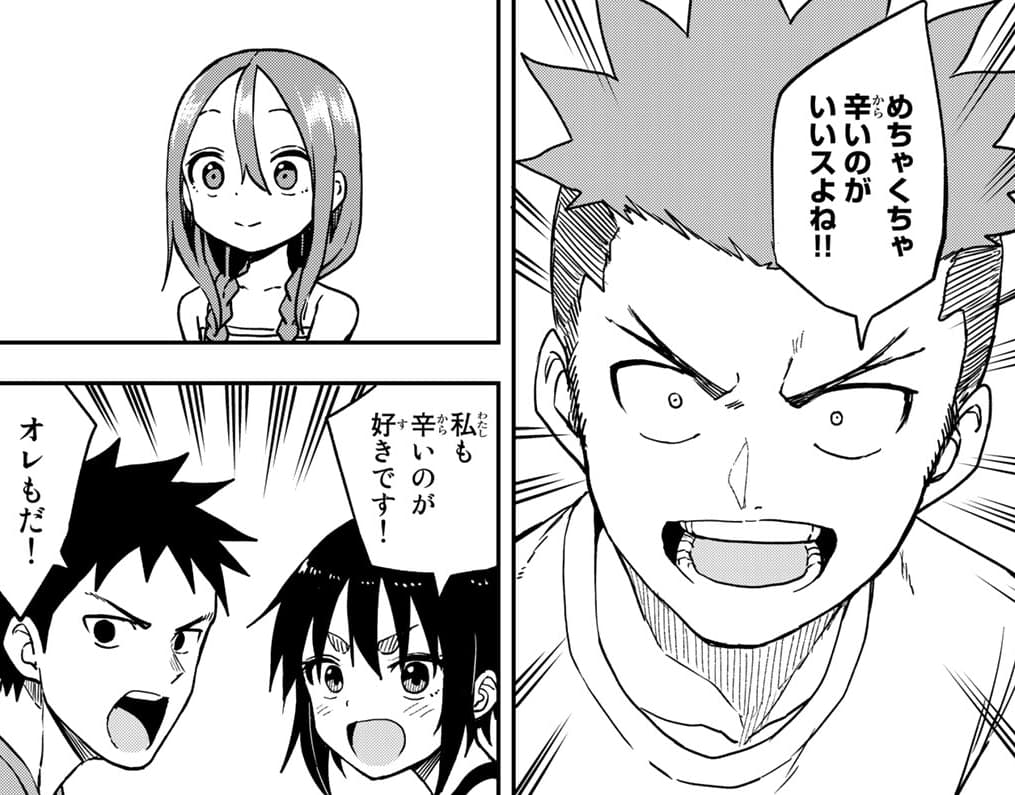
At a club retreat, curry is being fixed for everyone.

Takeru: 「めちゃくちゃからいのがいいスよね!!」

Subject: absurdly spicy one (referring to curry)
Adjective description: good

Rin: 「わたしからいのがきです

(Inclusive) Topic: Me (also)
Comment:
— Subject: spicy one (curry)
— Adjective description: like

5 Likes

This was so incredibly helpful, thank you! The way you presented it with the simpler examples first made it all click for me.

I’m almost done with the chapter, and then I want to review parts I struggled with to see if I can figure everything out or if I have questions.

4 Likes
Train Scene

Although not the same, this scene made me think of a scene from another manga from this mangaka:

3 Likes

Thanks for taking the time to go over this! It really helps to see clear examples of when to use which one

4 Likes
Train Scene Other Manga Response

Haha! That totally reminds me of what Itsuomi always does
「行く?行かない?」「する?しない?」Hahaha

What manga is that?? Only other manga I know very little about from the mangaka is shortcake cake

2 Likes

That one was next on my to-read list from this mangaka, but since Yubisaki won the poll, I’m holding off on starting Shortcake.

The screenshot’s from 日々蝶々.

4 Likes

Sign.6 声と波長

Start Date: 2025-09-26T15:00:00Z

Remember, two weeks for the chapter, so feel free to pace yourself. Aim for 20 pages per week, or 3 a day.

Don’t hesitate to ask about anything you are unsure of! It may take time, but it gets easier so long as you keep moving forward and keep learning.

Participation

Mark your participation status by voting in this poll. (You can change your answer later if you’d like.)

  • I’m reading along.
  • I have finished this part.
  • I will catch up later.
0 voters

If you’ve read it before but will join in the discussion (or have read ahead), please select “I’m reading along”!

4 Likes

Thanks for leading this! I don’t see the sign 6 vocab in the sheet – does that just mean I’m the first to look?

4 Likes

Sorry, I fell behind on the sheet! I started getting stuff in tonight but it’s not fully done yet. I’ll try to finish it tomorrow.

4 Likes

Vocab list is filled out for chapter 6! Again, if you find any errors, issues, please feel free to edit the list!

5 Likes

It’s mid-chapter time!

How are are you into chapter two?

  • I haven’t started yet.
  • I’m still in the first half.
  • I’m in the second half.
  • I already finished the chapter.
0 voters
2 Likes

Sign.7 見せたいとみてほしい

Start Date: 2025-10-10T15:00:00Z

Participation

Mark your participation status by voting in this poll. (You can change your answer later if you’d like.)

  • I’m reading along.
  • I have finished this part.
  • I will catch up later.
0 voters

If you’ve read it before but will join in the discussion (or have read ahead), please select “I’m reading along”!

3 Likes

Once again late on the vocab for chapter 7, but I’ll be working on it for the next few days.

In case you’re having trouble reading it like I was, here’s my best attempt (with help from ChatGPT) on deciphering the handwritten note on page 86:

✿ 制作裏話 ✿

手話は漫画で表現するのが難しいです。
どうやって漫画の中に変換されているのか
というと…

(手話協力して頂いている宮崎柚希ちゃんに
ネームが終わった段階でセリフの手話を
教えてもらい、メモをとる)
マキロ ↓
(手話セリフの動画を撮り、なちゃんに送る)
なちゃん ↓
(動画を見ながら手の動きを確認し、
描く単語を選ぶ(全ては描けないので)
下絵を描く)

下絵を担当さんと3人でチェック

漫画の中に登場!
簡単にいうとこんな感じです ◠‿◠

※ あと解説ですが
ふきだしの文字が薄くなっているのは
雪が相手の話している口の動き、
会話の文脈から単語を読み取って
いるものです。聞いてたりするものは
口話の読み取りづらさを表しています。

4 Likes