That makes sense, and having started that way and then recently compared having both versions, it doesn’t feel that much more insightful to be honest. It made me realise how much bang for my buck I’m getting out of those first 350 odd kanji.
4 Likes
@ChristopherFritz Just wanted to ping you as I know you also have a Boox tablet. I’m thinking of starting to read proper big slabs of text (novels, LNs, kid’s books etc) and was wondering what best practice is if I want to minimise fucking around with bullshit (i.e. unDRMing Kindle stuff) to be able to easily run a touch dictionary on it (i.e. a Mokuro or Yomichan-like, but hopefully with less messing around beforehand - ideal is buy, download and go).
For instance, 世にも奇妙な商品カタログ 1 インスタント死神・友だちクジ他 | L23 is currently on sale, I see it on a few places including Honto and Rakuten Kobo. What’s the best option for me?
4 Likes
I only read manga, so…let me know if you figuring anything out? 
If I were going to give it a try, I’d probably look into what ebook store apps support what dictionaries.
Here’s what I know:
Kobo: Worthless for this. No dictionary. It queries a highlighted word on English Wikipedia, even when the OS, app, login, and ebook are all in Japanese.
Amazon: You get a Japanese word dictionary with Japanese definitions. There is no Japanese word dictionary with English. Checking whether is was possible to install one, I found this, but reviews are a bit iffy.
I’m not a fan of Amazon using its own proprietary format over EPUB, but between these two, Amazon looks far superior to me.
2 Likes
Seems like the EPUB to ttsu to yomichan pipeline might be the way to go then. Thanks! Now I just need to figure out if that’s super easy from Rakuten or what
4 Likes
I buy on Kobo, then fire up a Windows virtual environment to download via the Kobo app, then deDRM through this application (among the best $60 I ever spent, as I’ve used it for hundreds and hundreds of manga, and I see the price has gone down over the years).
2 Likes
Good news, I figured it out. Though hopefully Rakuten Kobo never tries to call me because I just gave them a random phone number I found on the web… anyway, seems like the Kobo to ePub pipeline is relatively straightforward. If I thought their site was easier to navigate I might even try and swap my truly overburdened Kindle purchases over there. Do they only have these time-limited free manga?
3 Likes
If you need help along the way let me know! I have the precise steps written down, not sure it’s okay to post here because of the gray area of un-drm but you can find me on Discord
3 Likes
In my experience, Kobo typically (not always) gets the same “free forever” manga that Bookwalker has, but there’s no easy way to search for them on Kobo.
Since Kobo’s search is really bad (if I view too many search result pages, I get a soft ban from the site for a few hours…), I do all my lookups for anything interesting on Bookwalker, then do my purchases on Kobo.
6 Likes
From the Kobo store just using the calibre plugin named deDRM is enough to have an epub without DRM. You don’t need a paid tool for that.
It’s well documented on the internet, so I won’t post something here as removing the DRM of your bought stuff is still in a gray legal area depending on the country.
4 Likes
Unfortunately, I was never able to get this working. I spent enough hours trying that it was worth it for me to go the paid tool route.
But for anyone who can get Calibre working for this, I do recommend going that route.
5 Likes
It’s a day early for posting this, but that’s okay.
2023 in Review and Plans for 2024
In 2022, I completed reading 91 manga volumes and one light novel. It was my most packed year regarding the number of manga read, even considering I didn’t read as many omnibus-sized volumes as in prior years.
Midway through 2023, I knew there was no way I would reach that many manga this year.
So, how did my manga reading go in 2023? Which have I completed, and which am I still working through? And how did it compare with my goals for the year?
2023 Manga Goals and Completions
| Series | Goal | Completed | Met? | Continuing? |
|---|---|---|---|---|
| 6月のラブレター | 1 | 1 |  |
N/A |
| ARIA The MASTERPIECE | 2 | 1 |  |
Yes |
| Colori Colore Creare | 1+ | 0 |  |
Pending |
| orange | 2 | 2 | |
N/A |
| ××でも魔法少女になれますか? | N/A | 1 | No | |
| からかい上手の高木さん | N/A | 6 | Yes | |
| からかい上手の(元)高木さん | N/A | 3 | Yes | |
| きょうのキラ君 | N/A | 2 | No | |
| くノ一ツバキの胸の内 | 1+ | 2 | |
Yes |
| ご注文はうさぎですか? C.B. | 1 | 0 |  |
Yes |
| それでも歩は寄せてくる | N/A | 3 | Yes | |
| ないしょのプリンセス | 3 | 1 | |
Yes |
| ななか 6⁄17 | 1+ | 0 | |
Yes |
| ひとりぼっちの○○生活 | 2 | 0 | |
Yes |
| ひよ恋 | N/A | 8 | Yes | |
| ふらいんぐうぃっち | 1 | 1 | |
Yes |
| まじっく快斗 | 4 | 0 |  |
Undecided |
| アオのハコ | N/A | 4 | Yes | |
| シャドーハウス | N/A | 11 | Yes | |
| ストロボ・エッジ | 10? | 5 | |
Yes |
| ハチミツにはつこい | N/A | 4 | Yes | |
| ハナヤマタ | 1+ | 1 | |
Yes |
| ホリミヤ | N/A | 2 | Yes | |
| ポケットモンスタースペシャル | 1+ | 1 | |
Undecided |
| ルリドラゴン | N/A | 1 | N/A | |
| 古見さんは、コミュ症です。 | 1+ | 1 | |
No |
| 可愛いだけじゃない式守さん | N/A | 1 | Yes | |
| 名探偵コナン | 12 | 5 |  |
Yes |
| 夢みる太陽 | 10? | 10 | |
N/A |
| 好きな子がめがねを忘れた | 1+ | 2 | |
Yes |
| 日々蝶々 | N/A | 5 | Yes | |
| 春色アストロノート | 1 | 1 | |
N/A |
| 桜蘭高校ホスト部 | N/A | 2 | Yes | |
| 舞妓さんちのまかないさん | N/A | 2 | Yes | |
| 藤原くんはだいたい正しい | N/A | 4 | Yes | |
| 風の谷のナウシカ (シネマコミック) | N/A | 1 | N/A | |
| YAIBA | N/A | 1 | Undecided |
If my numbers and math are not mistaken, that’s 96 volumes. So close to 100, but not quite there. (Although if I count the omnibus ARIA as two volumes, then almost…)
I also started one or two novels/light novels but didn’t keep up with them.
2023 Completed Volumes Collage

2024 Manga Goals
For 2024, I want to reach 100 manga volumes read in one year.
What am I planning on reading in 2024?
| Series | Goal | Comments |
|---|---|---|
| ARIA The MASTERPIECE | 1 | Final volume! |
| Colori Colore Creare | 3? | Latest series by ARIA mangaka. |
| からかい上手の高木さん | N/A | Book club. |
| からかい上手の(元)高木さん | 6+? | |
| くノ一ツバキの胸の内 | 1 | Final volume! |
| この美術部には問題がある! | N/A | Offshoot book club? |
| ご注文はうさぎですか? CB | 1? | |
| それでも歩は寄せてくる | 2? | Waiting for next volume! |
| ないしょのプリンセス | 2? | |
| ひとりぼっちの○○生活 | 1? | |
| ひよ恋 | 6 | |
| ふらいんぐうぃっち | 1 | Waiting for the next volume! |
| まじっく快斗 | ? | |
| アオのハコ | N/A | Book club. |
| シャドーハウス | N/A | Book club. |
| ストロボ・エッジ | 5 | |
| ハチミツにはつこい | 8 | |
| ハナヤマタ | 6? | |
| ホリミヤ | N/A | Book club. |
| 可愛いだけじゃない式守さん | 2 | Offshoot book club? |
| 名探偵コナン | 6? | If I commit to weekly reading, I can aim higher. |
| 天野こずえ短編集 | 3 | Short stories by ARIA mangaka. |
| 好きな子がめがねを忘れた | 1 | Waiting for the next volume! |
| 日々蝶々 | 7 | |
| 桜蘭高校ホスト部 | ?? | This series is a struggle… |
| 浪漫倶楽部 | 6 | Older series by ARIA mangaka. |
| 舞妓さんちのまかないさん | N/A | Book Club. |
| 藤原くんはだいたい正しい | 6 | |
| 紅の豚 | 1 | Cinemanga. |
It’s difficult to pull a prediction of the total number of volumes out of that, but between these, offshoot book clubs, new book clubs, and any new series I may begin, 100 volumes in one year should be doable.
In 2021, I scheduled my reading, and I don’t remember it being an issue. I aimed to read one chapter of manga daily, with a specific manga tied to a specific weekday. Or two chapters for series with shorter chapters. I may try that again in January and see how it goes.
I just need to manage my progress to ensure I stay on track properly.

To that end, I have written some code in my “Mokuro bookshelf” to track (measure) my progress in 2024, including my goal to reach per day.
It calculates the number of days in the year to find out what my percentage of manga volumes read should be, then it counts my completed manga volumes and adds the percentage progress on what I’m currently reading.
The only thing missing is telling me how many pages I need to stay on target. This one’s difficult because each manga has a different total number of pages, so one page of a 120-page volume contributes more than one page of a 350-page volume.
I may consider adding a number to each manga cover telling how many pages of that specific manga volume I would need to read to reach my goal, but I may just be lazy and not.
I also want to try to incorporate at least one “no furigana” manga in my weekly reading. Reading volume 2 of 「ハナヤマタ」 has me feeling like easier “no furigana” manga is doable for me, and I know 「ひとりぼっちの○○生活」 will be fairly easy as well.
Programming
How did my (Japanese-related) programming goals go?
Book Club Manager
Although I made little progress most of the year, near the end I did a massive overhaul of the code and worked it into a Userscript.
There’s still plenty of room for improvement and minor features I’ve meant to add for a long time.
Manga Frequency Lists
My main programming has been updating my website’s manga frequency lists section.
There’s still more that I plan to do with it, but the code has reached a point where most of the functionality I’ve wanted for personal use is there.
I can track what I’m reading, what I have on hold, and what I’ve finished.
I can see which high-frequency words I should focus on learning in a series.
I’ve started looking into focusing on kanji in isolation to see if that helps with knowing reading and discerning meaning from unknown words that contain known kanji.
I can see how often I’ll be looking up words in a series, allowing me to determine in advance whether a series is more fit to read on the bus (difficult lookups) versus at home (easy lookups).
Next step: Develop easier tracking of where I am on the volumes I’m currently reading, about to read, or would like to read, including listing the highest frequency unknown words across said volumes.
Edit: Wow, there’s a nifty new built-in Discourse table editing tool. I can see that coming in handy.
18 Likes
I struggled a bit but got it to work eventually, the trick is to have a version of Calibre that supports the plugin, it won’t work with the newest one
6 Likes
The plan:
The reality these past couple of weeks:
- learning new programming things
- learning new web development things
- learning new database things
- implementing these things
The good news is that I am getting reading done on my bus commutes and during my breaks at work.
The bad news is I missed on my reading Ouran the past two weekends… (And don’t even ask me where I am on this week’s intermediate dictionary reading. I intended to read one grammar point per day this year, and I’ve missed that almost every day so far…)
As of today, I should be 10.4% of the way toward my 100-volume goal, and I’m sitting at 13.4%, so at least I’m still ahead! (For now…)
My non-reading time has been well spent so far, I feel.
I’ve been working to split off the manga frequency lists from my personal Japanese learning site to their own site.
As it is, having Jekyl generate the static HTML pages for my site takes a couple of minutes, and modifying a page takes at least half a minute for Jekyl to handle. I have some workarounds for when working on content, but it’s only getting worse as I add more manga frequency lists.
Also, there are limitations to my use of a Javascript layer for tracking known words and progress in reading manga. Namely, when marking words as known for one series or volume, there’s no way to mass-update the stats for all other series/volumes. My implementation of sentence-based stats was also a bit clunky.
The branched-off site for manga frequency lists and known word tracking is dynamic, built on top of a Javascript + database backend.
I still have a bit of work to do on it for it to reach parity with the origin site, but so far so good.
14 Likes
It’s too soon to say for sure, but I think I might be almost back to using SRS (for real this time).
At least, I’ve kept at it for roughly a whole week now.
My current process for mining words is:
Check for unknown words in manga volumes I plan to read soon.

(You know that feeling when you’re reading and encounter a word you just started learning? This helps produce that.)
Put the word into Migaku’s Card Creator and let it auto-populate the fields.

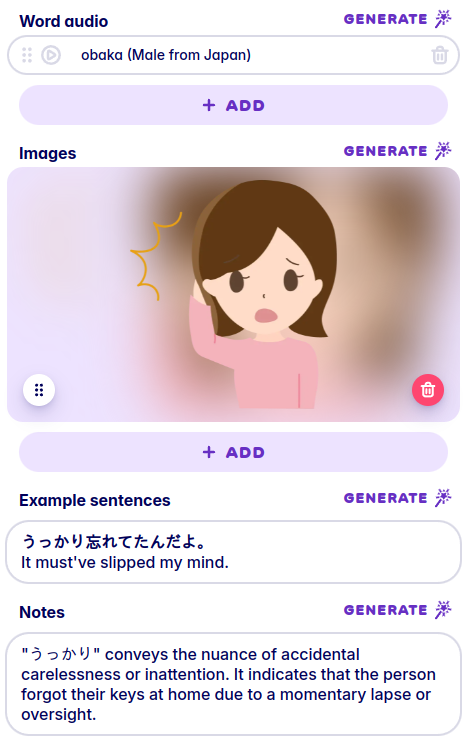
(Note: The comment in the “notes” section is in the context of the sentence in the “Sentence” section.)
Sometimes create cards for unknown words encountered while reading, but typically only if they are higher frequency in the kind of manga I read.
For example, this one I wouldn’t bother creating a card for:

I’m up to 40 cards so far in week one.
I’m still behind on my intended daily reading, especially for weekends, due to continued work on my manga frequency website.
But my bus commute reading sessions and my break and lunch break reading sessions at work keep me on target.
We’re 13.1% of the way through 2024, and I’m 17.8% of the way through my goal of 100 manga volumes.
16 Likes
Same…I vibe this 100%
Life… Always intervening with our plans ね〜
5 Likes
Two months and a week into the year, how are things looking?
Reading
I’ve passed 25% into my goal of reading 100 manga volumes this year.
Somehow, I’ve ended up being actively reading volumes from 20 different series, with 「老女的少女ひなたちゃん」 ready to be added when the book club starts.
I actually planned to keep it from going over 20, but reading through 「日々蝶々」 I saw this come up:

Expecting a crossover chapter, I picked up 「虹色デイズ」 (which was on my “consideration” list) to get to know the characters.
But, as it turns out, it was only a single-page crossover image, not a crossover chapter… So I increased the series I’m reading by one needlessly…
The downside to tracking my percentage of words known for an increasing number of manga is seeing an increasing number of manga that are good candidates for reading on my bus commute.

On one hand, I have enough to read on the bus already. On the other hand, I’d love to get a bit more variety than yet another high school romance (which is…probably the majority of what’s in that screenshot).
The upside to tracking is watching the percentage of known words and readable-without-lookups sentences creep up a smidgen every now and then for series I’m considering reading next (after reducing my current load):

SRS Flash Cards
Manga frequency lists + Migaku one-click card creations = I’m (slowly) amassing a number of flash cards for daily review.

The count is still small enough that reviews to just a few minutes a day, but I’m sure the time requirement will go up over time as I create more cards.
I just need to see how long I keep up those daily reviews!
14 Likes
Loving to see all those trackers!
Happy cake day by the way 
6 Likes
Disclaimer: This is a programmy post.
Frequency lists are my favorite “tool” when it comes to learning Japanese.
Since re-starting SRS recently, I’ve generated 131 vocabulary cards in Migaku, most of which are from frequency lists.
I’d like to get back into using SRS for kanji as well. This would be used for a few scenario:
- I recognize a kanji only when it’s used in a specific word, but not in others.
- I know the reading of a kanji only when I see it in a specific word, but not in others.
- I’m struggling to learn a vocabulary word because I do not recognize a kanji in it.
My original Japanese-learning web site that I tacked frequency lists onto, at one point I added a layer for kanji. This allows viewing kanji by frequency, and splits learning them into:
Meanings:

Readings:

For my newer site, which is specific to manga frequency lists, I’ve started to set up the same data, currently displayed in one view:

The issue I have with both designs is that it doesn’t distinguish the readings for the kanji used in the manga the list is being pulled from.
For example, consider the following word list:

The only vocabulary in this series (based on available volumes) that use the kanji 応 are read as either 「おうえん」 on 「はんのう」. Yet, three おん and three くん readings are presented here.
I’d rather have something like this mock-up:

I would likely split the kanji list into three: meaning, おん reading, and くん reading. (With possible future support for other readings.)
The main issue? I don’t have easy access to knowing whether a word uses the おん or くん reading for each kanji.
The solution? Write code to figure it out, then store the data in the site’s database for quick and easy access.
To get the possible readings, I’m using the Kanji Data JSON file.
I’m using data from JMDict, so I have the kana for each word.
My code (which I probably should put on GitHub):
// word: this is the word with kanji
// reading: this is the kana reading of the word
function getKanjiReadings(word, reading) {
  let remainingReading = reading

  let results = []

  for (const character of word.split('')) {
    if (!(character in kanjis)) {
      remainingReading = remainingReading.substring(1)
      continue
    }
    let onMatchFound = false
    if ('readings_on' in kanjis[character]) {
      for (const onReading of kanjis[character].readings_on) {
        if (!remainingReading.startsWith(onReading)) {
          continue
        }
        results.push({ kanji: character, type: 'on', reading: onReading })
        remainingReading = remainingReading.substring(onReading.length)
        onMatchFound = true
        break
      }
    }
    if (onMatchFound) {
      continue
    }
    let kunMatchFound = false
    if ('readings_kun' in kanjis[character]) {
      for (let kunReading of kanjis[character].readings_kun) {
        if (kunReading.includes('-')) {
          kunReading = kunReading.replace('-')
        }
        if (kunReading.includes('.')) {
          const kunReadingSplit = kunReading.split('.', 2)
          if (!remainingReading.startsWith(kunReadingSplit[0])) {
            continue
          }
          results.push({ kanji: character, type: 'kun', reading: kunReadingSplit[0] })
          remainingReading = remainingReading.substring(kunReadingSplit[0].length)
          kunMatchFound = true
          break
        } else {
          if (!remainingReading.startsWith(kunReading)) {
            continue
          }
          results.push({ kanji: character, type: 'kun', reading: kunReading })
          remainingReading = remainingReading.substring(kunReading.length)
          kunMatchFound = true
          break
        }
      }
    }
    if (kunMatchFound) {
      continue
    }
  }
  return { word: word, results: results, success: remainingReading.length === 0 }
}
I haven’t tested this extensively yet, but it’s working on the words I have tested it on:
{
  "word": "簡単に言うと",
  "reading": "かんたんにいうと",
  "results": [
    { "kanji": "簡", "type": "on", "reading": "かん" },
    { "kanji": "単", "type": "on", "reading": "たん" },
    { "kanji": "言", "type": "kun", "reading": "い" }
  ],
  "success": true
}

{
  "word": "一目",
  "reading": "ひとめ",
  "results": [
    { "kanji": "一", "type": "kun", "reading": "ひと" },
    { "kanji": "目", "type": "kun", "reading": "め" }
  ],
  "success": true
}

{
  "word": "いい顔",
  "reading": "いいかお",
  "results": [
    { "kanji": "顔", "type": "kun", "reading": "かお" }
  ],
  "success": true
}

{
  "word": "叶う",
  "reading": "かなう",
  "results": [
    { "kanji": "叶", "type": "kun", "reading": "かな" }
  ],
  "success": true
}
Not supported:
- Kanji readings that begin or end with a dash have that reading at the end or start of a word. My code ignores this.
- Kanji readings with a period will have certain characters follow aftter the kanji. My code ignores this.
- I haven’t yet tested any words that use rendaku.
9 Likes
Could I ask for some coding help sounding board stuff to do with frequency?
I currently maintain private vocab spreadsheets for everything i read where i put down the words i don’t know. (Sample for DunMeshi).
Right now I manually check each word against a frequency distribution list integrated in yomitan. The file is just a JSON which gives a star ranking based on frequency.
I would like to automate this process if possible. Any idea where I would even start?
/edit specifically the only thing i really want to automate is the star rating stuff; the process of putting the words in + pronounciation + meaning i like doing manually
3 Likes
For Google Sheets, I recommend putting Yomichan’s frequency data directly into a sheet in your spreadsheet file.
This would be similar to what I have for Frieren, except you would have the entire Yomichan frequency list rather than a limited list of words:

Then access the frequency via a formula, something like:
=IFNA(vlookup(B2,Frequency!A:C,3,false), ""))
(Where B2 is the word you’ve added from your reading.)
If you need any help getting the data from JSON to something you can put into Google Sheets, let me know.
And if I missed anything or didn’t answer quite what you were asking, let me know!
5 Likes