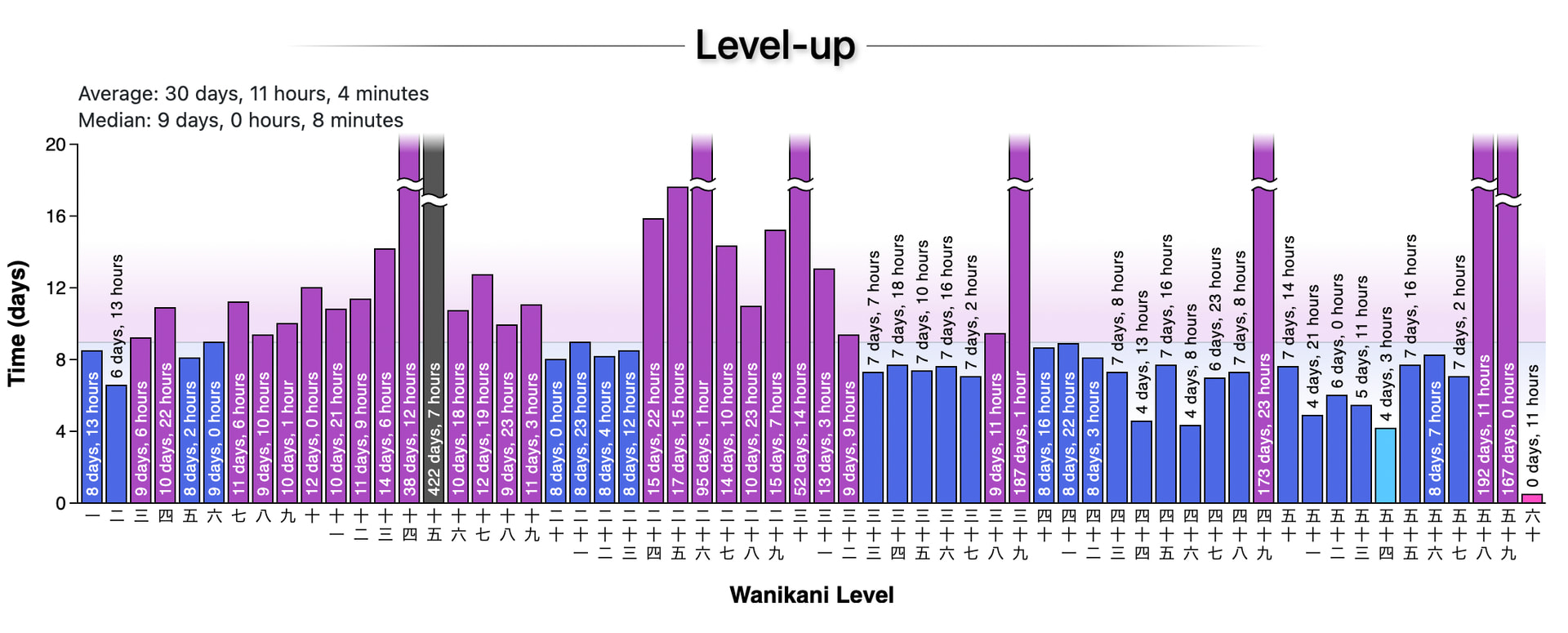
Level 60 - 4 years, 11 months and 7 days!

Hello, Everyone!!

Today I finally reached level 60! It took me 4 years, 11 months and 7 days (see the timeline and currency status figures above), but I’m very happy that I can now read Japanese newspapers and novels. But the path was not always easy, as you know. During some years with WaniKani, I couldn’t find time to study, yet for some reason I never put it in vacation mode. When I returned, the number of reviews was overwhelming—sometimes 2,000 or even 3,000. The longer I stayed away, the harder it was to remember the kanji.

I decided to move slowly and focus on reducing the huge backlog. After a few weeks, I gradually increased the number of daily reviews until I could handle a high and consistent load (around 300 reviews per day). To do that, I needed to choose a vacation period when I had enough time to focus on studying.

I first studied Japanese decades ago, when looking up a word meant counting kanji strokes, guessing readings, and checking multiple dictionaries—a long process of trial and error. After more than 30 years away from Japanese, returning to it in my 50s feels almost like a miracle. I’m deeply grateful to WaniKani for making this miracle possible. Balancing full-time work, family, and community commitments once made studying Japanese feel impossible, but technology has changed that.

This year I also passed JLPT N2, and I feel much more comfortable speaking Japanese thanks to my tutors on italki and Cafetalk.

I’m also very grateful to my husband. He encouraged me to start learning Japanese now, rather than postponing it to some future time when I might have “more time.”

Two years ago, I went to Tokyo for the second time. My first visit was before WaniKani, and this one was after. It was incredibly exciting to walk around and be able to read the signs. For me, the ability to read brings freedom—like having wings to fly.

Going forward, I plan to keep reviewing kanji with WaniKani (while dedicating less time to it), studying grammar with BunPro, reading Japanese novels and newspapers, watching some Japanese programs, and continuing conversations with my tutors.

Wishing everyone good luck and happy holidays!

61 Likes

Congratulations on an amazing achievement!

I have a similar history. The internet makes studying Japanese outside Japan much more possible!

11 Likes

Saty4353 - omedetou gozaimasu! Thank you for taking the time to post about your journey! I also am in my 50s with full time commitments. I started studying Japanese in college, and taught English in Kagoshima-Ken on JET for a year after. Life took over, and I have had a career and now nearly grown kids in their 20s. About 18 months ago, I discovered Wanikani in a news article I can no longer find, and I thought wow, instead of doing the stupid Duolingo Japanese things, why don’t I take this language on in a different way, and think that the platform is funny, engaging and forgiving. I’m only on level 18 (I had to go back and repeat a few levels when I put it down for too long). Yet, I absolutely look forward to my reviews every day now and plugging along. I appreciate you sharing how long it took you and your story of persistence. Also, where do you get that cool Level-up chart??! Best wishes that you get to travel again to Japan more soon, don’t wait. I went last year to go see my fellow teachers in my small Kagoshima town and hadn’t seen them for 30 years. The ability to read and communicate with them….well, that is the stuff of priceless life memories.

12 Likes

Thank you, @lamchop68 !
The thing is that because Wanikani is structured to get the most frequently used kanjis first, when we get around level 30, we can already read lots of things… so level 18 is already very good … And our brain is fantastic being able to retrieve so much information that before Wanikani I did not realize how powerful it is! I did not go back any level, in fact… and you will see in my chart that I stopped using wanikani for more than a year without vacation mode….

The level-up chart:

  1. Go to Wanikani website.

  2. Click on the bird/egg icon, and then ‘API tokens’:

  1. Then:

  1. copy the code.

  2. Go to another website: wkstats

  3. paste the code in that wkstats, and then you will see many different charts.

Good luck at your JP learning journey! 頑張りましょう!!

5 Likes

Hey Congratz! :smiley:

I’m just starting out but its really good to see that you can get to the point you can read Japanese newspapers. I guess this method works then huh? :slight_smile:

(I’m likely to work in Japan for a period next year so hopefully this will help me understand the road signs at least… even if I can’t quite figure out the menu!).

6 Likes

Congrats! That’s an inspiring journey, I hope you can enjoy using the language more and more on your next trips

That’s such a fun comparison!

4 Likes

So True. So True. So True. I think about this very often when studying. Congrats on 60!

2 Likes

Well done! Good luck with the further studies.

1 Like

Congrats. I also try to learn Japanese 2 decades ago. I’m also close to 50 years old. I hope to reach 40-50 level in 1-2 years.

3 Likes

How easy do you find it to read Japanese novels? I’ve been reading manga for a while and I regularly hit kanji and especially vocab I don’t know. I also recently tried playing a JRPG in Japanese and in virtually every dialogue box there would multiple words I had never seen before. It was painfully slow going.

I feel that the vocab part of wanikani is fairly weak. It teaches a decent basic foundation of words, with lots of gaps, but in the real world it’s nowhere near enough.

1 Like

Congrats @Saty4353! And also congrats on the JLPT N2, that’s a big achievement!

I personally find novels easier than manga, because the sentences tend to be more “completed” while in manga there are always a lot of words missing that you need to infer.
It is rough at the beginning, but then you slowly get used to the same vocab behind reused (such as verbs often used when talking, “to nod” and the like).
If you already have a bit of experience with manga, then I recommend that you try joining the Intermediate Book Club. We read a novel together, with people of varying level of Japanese. So there will be a lot of people that can help if you have questions.
Joining book clubs has always helped me a lot to make the jump and dare things I didn’t know I was ready for, so I highly recommend! Plus, you are in luck, the next book is starting in a week, and it’s free because there’s no copyright on it anymore. It is also possible to read it in your browser, which makes it easy to use Yomichan for lookups, or copy sentences in a machine translator.
So if you are interested, join here: 怪人二十面相 🦹 (Intermediate Book Club) [starting January 3rd] :slight_smile:

2 Likes

Thank you!

Definitely; with internet, the hurdle is much lower to learn a language….

Hi @Ali-Star . Yes, learning with Wanikani definitely works for us to read newspaper and whatever we want… I found that watching the Japanese news and seeing the highlights in kanji have helped me when I was around level 25-30… because then we could see the images and then the kanjis so we start to recognize the ones we learned…

1 Like

Hi @kotatsu . I understand your frustration. The first novel I read was extremely hard, but after that, things gradually became much easier. So far, I’ve read about 4–5 novels, 4–5 nonfiction books, and many children’s books.

There’s a children’s book series I really like because it covers many genres—biographies, science, and classic Western and Japanese literature—and it’s divided by difficulty level, from Grade 1 to Grade 6. I especially enjoy the science books because the content is more objective and easier to guess from context. For example, there’s a book called 「なぜ?どうして?科学のお話」 for fifth-grade students. There are many titles on different topics, all with furigana, and they’re also available on Kindle, which makes looking up words much easier.

I think WaniKani provides a strong foundation, but everyone still needs to build vocabulary that matches their own goals. I’ve noticed that vocabulary in games is often much harder than what you find in popular books or newspapers.

I also start and stop many books until I find one that keeps me motivated. Sometimes I give up because the level is too high; other times, the topic just doesn’t interest me. It’s a lot of trial and error, but the more contact we have with the language, the better we get.

My last suggestion is to invest time in grammar study. Vocabulary alone isn’t enough for full understanding. I personally struggled to focus on grammar, but after reaching a solid level with WaniKani and shifting much of my time to BunPro, my grammar knowledge became much more organized through constant review.

I hope these tips help in some way. Good luck!

2 Likes