Aw thanks I appreciate it. You are also cool!! This became a treatise while I ate my lunch so hope I didnt ramble too much but:
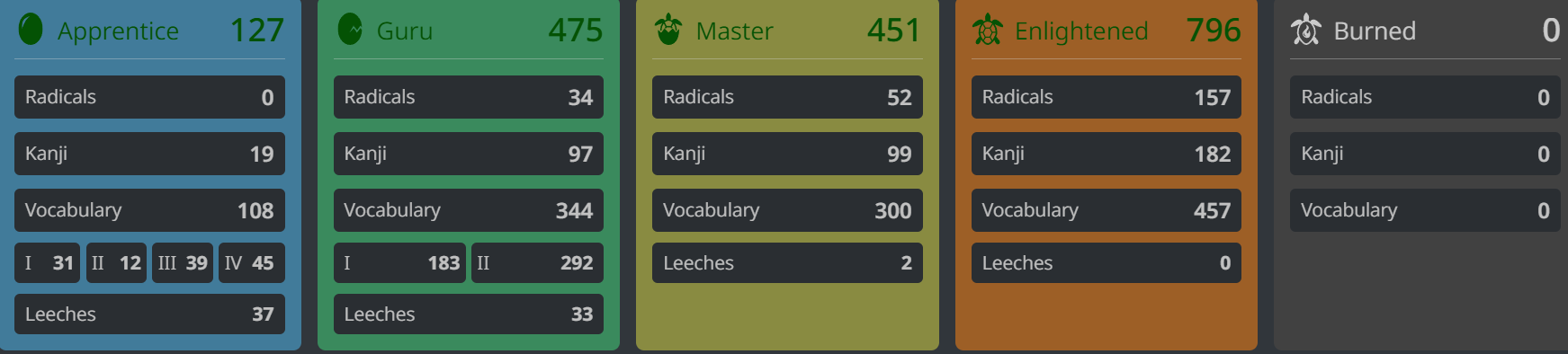
I’ve been immersing for the long run since starting wk in shoujo manga and otome visual novels so my thing was like, I’d rather “review” the kanji through immersion and get to that 2k kanji wanikani will get you to as soon as possible, rather than doing it perfectly and taking a longer time to easier overall immersion.
like for instance this sentence on jisho: * 両親 は 彼 を 静める のに成功した. I feel like if you know 彼 really well, but have not yet learned 両親 or 成功 or even 静める(let alone if theres an alternative kanji being used), then youre still looking up a lot of this sentence and spending a lot of time on it. And that’s okay, but in the grand scheme of it if youre playing this awesome jp-lang only game, and you’ve spent 15 minutes on this sentence, dictionary searching, simmering on the usage of particles, you still have a long, long way to go to get to the “good part”. If I know 両親, 彼, 静, and 成功, even if at 80% still a little hazy but I understand the vibes, I can move onto more of the fun stuff. Spending that much time on a sentence isn’t bad dont get me wrong, and I also had to do that early on when I was still getting used to reading japanese, but at this point I want to just keep immersing and enjoying these cool stories, and as I do that, I also still get better at japanese.
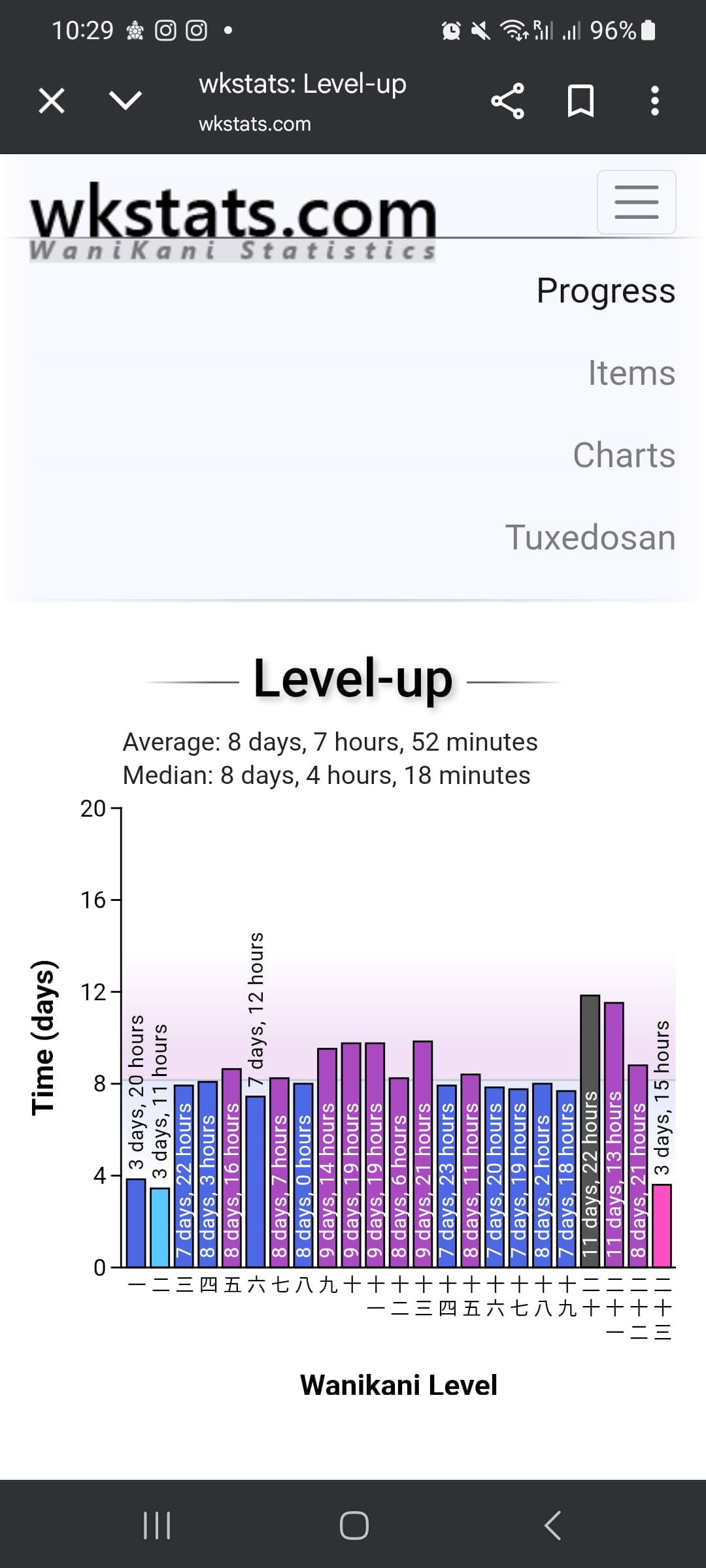
I also found that even after wanikani level 60 I had a lot of trouble remembering kanji while immersing that I never missed on wanikani. There’s something about seeing the words here on wk, in this website as flashcards, versus seeing the kanji in an immersion sentence in a game that can just totally throw me off. Lately this has not been the case, but it took me from October 2024 to maybe June 2025 to be able to integrate what I learned from wanikani and be able to recognize most things consistently. I’ve heard the same from other people here, where theres a shift from doing well on wanikani versus when youre actually reading native content. maybe its something in the brain and the activation of “flashcards” and getting the “right” answer versus actually reading a sentence. And that doesnt also account for the many different definitions you can encounter for a word you learned on wanikani as meaning x, but in your reading you come across that it can also mean y. For instance, かつぐ or 担ぐ you learn in level 24 that its “to carry” and while yes, I also ran into a sentence in Harukanaru 4 where our character was talking about a local legend and a character said "馬鹿馬鹿しいかつがれたんだよ” which here has more of the definition of “being caught up in superstition” or “being deceived, or taken for a ride”. That’s not a fault of wanikani, but it’s another example of how this program is about progression over perfection. If when we learned 担ぐ we had to learn all 4 definitions of the word, then it would be a perfect understanding, but we learn “to carry” and that “carries” us enough to where we need to be.
I think for immersing it’s better to know a lot of things well rather than a few things perfect. A lot of times I game, for the first hour or so of a VN I’m looking up words I don’t know or am hazy on- sort of using it as a more fun way to learn vocabulary, but after a certain point I’m like “I just want to enjoy the story” and unless I’m just truly at a loss for what a sentence means or it’s something I really want to understand, I just get the vibes and sense from both context and my understanding of most of what’s going on, even if I couldn’t translate it perfectly or I may be missing some nuance. This also changes from media to media- in Ayakashi Gohan, a game about living with and cooking for Ayakashi, for whatever reason, I’m just flying through and have only made about 38 flashcards for about 15 hours so far? Words like むく, to peel, つやつや glossy, bright, 線香 incense stick- versus Harukanaru 7, a game about the sengoku period and being the daughter of Oda Nobunaga, I must’ve made 400 or so flashcards. I could follow enough but it was much much slower. I also only make flashcards for common and uncommon words but not “rare” level words unless they’re a 気 expression or a fun kanji idiom.
But there’s so much kanji and so many alternative kanji!! for words we know so well like 静める like 鎮める that of course I do know but not that alternate so I have to learn that too. so all that to say- I think its better to use wanikani as a good base and then leave it behind. I hope they dont make levels 61-70 because I won’t do them and I would be sad not to be a level 60 gold member anymore. But it makes no sense to come back for me, I made my own flashcard system, game and read everyday, and am doing well. Leaving wanikani was a hard transitional period from the safety of being spoonfed everything, but now im doing much better. We’re not doing wanikani to be good at wanikani but doing it to be good at the language



 . But eventually I know it’s for the best and I will memorize them same as before