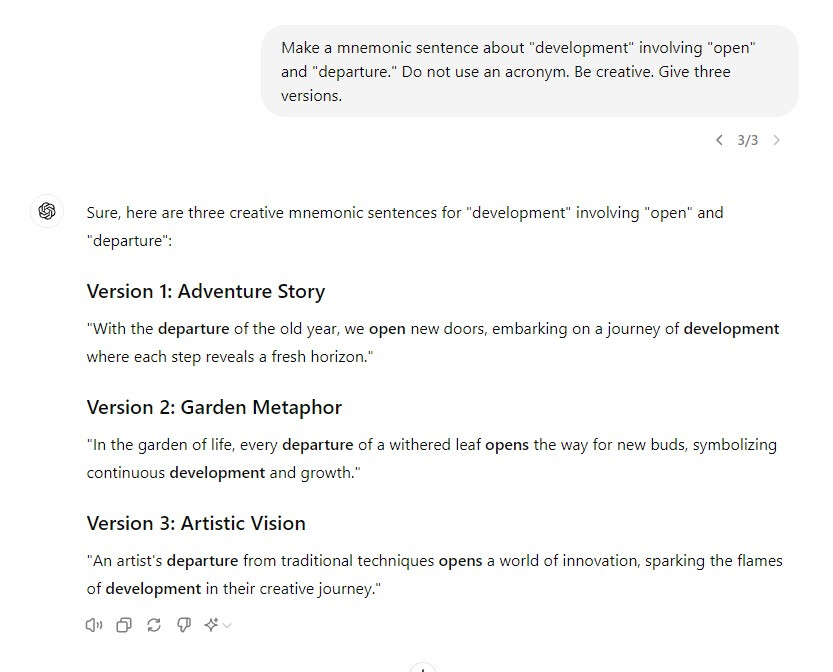
Is it cynical of me to assume that it stole that line from someone else? 
Can’t prove it, though…
Is it cynical of me to assume that it stole that line from someone else?
Can’t prove it, though…
This one’s a keeper. 
If it did, it’s not on Google (I don’t think the LN has a translation); and in its other draft translation it picked a different alliteration (“excitement, not enemies!”), so I’m inclined to believe it didn’t just have the line in its input corpus.
This is brilliant, I just got this mnemonic for 収納 (storage) which has been a leech for a while for me.
Shoe Gnome Storage: Imagine a tiny gnome who lives in a shoe. The gnome uses the shoe as a special storage (収納) place for all his treasures. “Shuu” for shoe and “nou” for gnome.
That’s a leach for me too! That mnemonic is great!
I very often have problems remembering some combinations of words (kanji meanings) like this one (kaihatsu).
It took some massaging the request into ChatGPT, but it works for me. (When asked for mnemonics for English words it unfortunately often tries to treat them as acronyms - for “development” that’s too long and unhelpful, but for “plan” it could work.)
Thanks for the inspiration! 
It is a pretty good assistant. I usually ask to explain some grammatical rules for Italian and its explanations are to the point and easy to understand.
Nice suggestion to use it for mnemonics!
Some mnemonics just don’t stick and using an AI Assistant is a great idea! I will try with Google Gemini. Thanks.
This is working quite well for me. ChatGPT comes up with some really effective mnemonics.
Today’s favourite is for 近づく - to approach. I explained that I was already comfortable with 近 meaning “near” so just needed help with attaching the づく part.
The answer was to think of a cute duck, dzuku, who waddles towards objects that it likes. Super cute and memorable!
One of the coolest things about learning this language is getting first hand experience of effectively hacking my own memory. It really works!
One more prompt I’ve been using to give me better example sentences that let me focus on my mistakes. This time with GPT-o1
“Create an example sentence for each of these words in Japanese. Use simple words for all the other words in the sentence. Provide all example sentences first one after another. Then provide the same example sentence, the word and it’s translation, and a translation of the example sentence along with an english pronunciation.
{list of kanji and vocabulary I got wrong}”
Example output
Example Sentences
この文章は重要な部分を省きました。
私たちは共同でプロジェクトを進めます。
{more…}
Detailed Sentences
Sentence: この文章は重要な部分を省きました。
Word: 省く (はぶく - habuku) – to omit
Translation: This sentence omitted the important part.
Pronunciation: Kono bunshō wa jūyō na bubun o habukimashita.
Sentence: 私たちは共同でプロジェクトを進めます。
Word: 共同 (きょうどう - kyōdō) – cooperation
Translation: We will advance the project through cooperation.
Pronunciation: Watashitachi wa kyōdō de purojekuto o susumemasu.
Sentence: 自然を保つことが大切です。
{more…}