# Reading does not match Kanji (but is not Ateji either, I think?)
**URL:** https://community.wanikani.com/t/reading-does-not-match-kanji-but-is-not-ateji-either-i-think/28510
**Category:** Kanji
**Created:** [February 21, 2018, 4:33pm UTC](https://community.wanikani.com/t/reading-does-not-match-kanji-but-is-not-ateji-either-i-think/28510 "2018-02-21T16:33:40Z")
**Posts on this page:** 11
**Page:** 1
### Author:  [@raegefilth](https://community.wanikani.com/u/raegefilth)
#### Post date: [February 21, 2018, 4:33pm UTC](https://community.wanikani.com/t/reading-does-not-match-kanji-but-is-not-ateji-either-i-think/28510/1 "2018-02-21T16:33:40Z")
In this short manga I’ve read the other day, I noticed something strange:

The furigana reads 今日 even though 翌日 (よくじつ) is meant, apparently, and I wonder why that is? Obviously “today” and “the following day” aren’t the same thing. Why not just write 今日 in the first place?
---
### Author:  [@MissMisc](https://community.wanikani.com/u/MissMisc)
#### Post date: [February 21, 2018, 4:49pm UTC](https://community.wanikani.com/t/reading-does-not-match-kanji-but-is-not-ateji-either-i-think/28510/2 "2018-02-21T16:49:06Z")
From my understanding, sometimes the writer/artist will _choose_ certain kanji to better express a nuance they’re going for for some words, so it will be “said” one way (きょう), but will then assign a different, specific kanji to represent the word in writing (翌日)
So though they’re saying “today”, the nuance might be something you can only get my reading it and seeing that they use the kanji 翌日 to represent it, so they might actually be referring to something occurring the following day – but since I don’t know the context, I’m not entirely sure if this interpretation fits!
I also found [this explanation](https://japanese.stackexchange.com/questions/5565/why-do-some-kanji-have-furigana-that-are-not-valid-readings) on stackexchange that goes into a bit more detail about it, it’s basically a stylistic trick writers can utilize in written Japanese text to say one word, but provide an implication of something else by assigning a different kanji to the word
Example from the site:

Meaning: “You can’t be trusted”
They’re _ **saying** _ “おまえ/you”, but chose to use the kanji 泥棒 to represent it to give a nuance that “You can’t be trusted _(because you are a thief)_”
---
### Author:  [@Protonstorm](https://community.wanikani.com/u/Protonstorm)
#### Post date: [February 21, 2018, 4:55pm UTC](https://community.wanikani.com/t/reading-does-not-match-kanji-but-is-not-ateji-either-i-think/28510/3 "2018-02-21T16:55:14Z")
MissMisc is right, a good example of this is the series 約束のネバーランド (The Promised Neverland) which is currently one of the most popular manga in Japan. The author Kaiu Shirai uses this technique on almost every page. The main characters in the series often speak to each other or think of people in multiple ways at once. One such example is when the kids call the caretaker “mother” but are also thinking that she is their “enemy”, and thus the author might have the reading be for “mother” but the actual kanji be “enemy”.
---
### Author:  [@LostProphet](https://community.wanikani.com/u/LostProphet)
#### Post date: [February 21, 2018, 5:05pm UTC](https://community.wanikani.com/t/reading-does-not-match-kanji-but-is-not-ateji-either-i-think/28510/4 "2018-02-21T17:05:30Z")
This is a commonly used technique, as described by the previous posters.
> **[Alternate Character Reading - TV Tropes](https://tvtropes.org/pmwiki/pmwiki.php/Main/AlternateCharacterReading)**
>
> The pronunciation of most Japanese words is not easily gleaned from how they are written. In the Japanese Writing System, words written in kanji often have multiple pronunciations depending on context. Basically, there are two main reading styles …
and here is another neat example to convey 2 meanings through one word in ホリミヤ
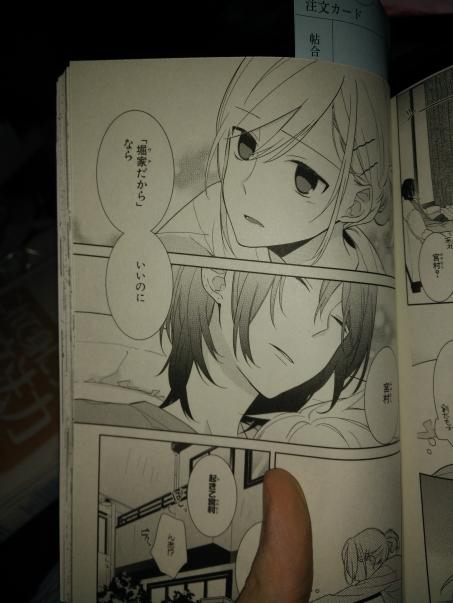
Edit, cause image quality is worse than on discord. hori says 堀家 ほりけ and the furigana says うち
---
### Author:  [@rhet](https://community.wanikani.com/u/rhet)
#### Post date: [February 21, 2018, 5:08pm UTC](https://community.wanikani.com/t/reading-does-not-match-kanji-but-is-not-ateji-either-i-think/28510/5 "2018-02-21T17:08:01Z")
Here’s an older thread on the topic:
> [@Why the strange kanji usage in song lyrics?](https://community.wanikani.com/t/why-the-strange-kanji-usage-in-song-lyrics/24767/5):
>
> This is extremely common in everything from manga and games to novels, not just song lyrics. It’s a rhetorical device (表現技法). Nath already explained it but here’s a quote from the Wikipedia page for furigana: また漫画や小説、歌の歌詞などでは、特殊な効果を狙って、漢字や外来語で記したものを全く別の振り仮名で読ませることもある[2]。 and here’s a relevant part from 日本人の知らない日本語 (skip to 3m 2s if it doesn’t automatically start there): [[Nihonjin no Shiranai Nihongo EP04 (English Subs)] ](https://www.youtube.com/watch?v=R8fucfOdF9g)
---
### Author:  [@raegefilth](https://community.wanikani.com/u/raegefilth)
#### Post date: [February 21, 2018, 5:11pm UTC](https://community.wanikani.com/t/reading-does-not-match-kanji-but-is-not-ateji-either-i-think/28510/6 "2018-02-21T17:11:04Z")
> [@MissMisc](#):
>
> So though they’re saying “today”, the nuance might be something you can only get my reading it and seeing that they use the kanji 翌日 to represent it, so they might actually be referring to something occurring the following day – but since I don’t know the context, I’m not entirely sure if this interpretation fits!
It does fit, thank you! 😊 I wasn’t sure whether the full sentence and/or context would have been necessary for a single word, but yeah it’s just like you said.
---
### Author:  [@raegefilth](https://community.wanikani.com/u/raegefilth)
#### Post date: [February 21, 2018, 5:18pm UTC](https://community.wanikani.com/t/reading-does-not-match-kanji-but-is-not-ateji-either-i-think/28510/7 "2018-02-21T17:18:46Z")
Cheers! I’m watching the video you posted and now I feel called out because that’s exactly how I memorized the on’yomi for 輪, haha…
---
### Author:  [@Syphus](https://community.wanikani.com/u/Syphus)
#### Post date: [February 21, 2018, 5:55pm UTC](https://community.wanikani.com/t/reading-does-not-match-kanji-but-is-not-ateji-either-i-think/28510/8 "2018-02-21T17:55:40Z")
> [@LostProphet](#):
>
> This is a commonly used technique
Commonly used technique in Manga as it is a way to make things “deeper” without really making them harder. But it’s rare I see this in adult literature, or I feel even in Seinen Manga.
---
### Author:  [@LostProphet](https://community.wanikani.com/u/LostProphet)
#### Post date: [February 21, 2018, 6:27pm UTC](https://community.wanikani.com/t/reading-does-not-match-kanji-but-is-not-ateji-either-i-think/28510/9 "2018-02-21T18:27:38Z")
oh definitely, thanks for adding that part 😃
---
### Author:  [@Belthazar](https://community.wanikani.com/u/Belthazar)
#### Post date: [February 21, 2018, 8:16pm UTC](https://community.wanikani.com/t/reading-does-not-match-kanji-but-is-not-ateji-either-i-think/28510/10 "2018-02-21T20:16:10Z")
One use of furigana that I quite like the idea of is the Negima manga - Negi’s spells are written in kanji, but the furigana is written in katakana-ified Latin.
> [@Protonstorm](#):
>
> MissMisc is right, a good example of this is the series 約束のネバーランド (The Promised Neverland) which is currently one of the most popular manga in Japan. (snip)
Ohhh. I just started reading the English version of this. So that’s why it comes across a little weird at times.
---
### Author:  [@system](https://community.wanikani.com/u/system)
#### Post date: [February 21, 2019, 8:27pm UTC](https://community.wanikani.com/t/reading-does-not-match-kanji-but-is-not-ateji-either-i-think/28510/11 "2019-02-21T20:27:25Z")
This topic was automatically closed 365 days after the last reply. New replies are no longer allowed.