


Hello! I’m taiyousea and I’ve just hit Wanikani level 60 after 2.5 years! During this time, I’ve finished many textbooks and workbooks, taken several speaking/writing/reading exams, given full presentations in Japanese, read lots of manga, finished a few novels, and I will be taking the N2 in this coming December. None of it was intended, not a single one of these activities was on my mind when I started learning, but all of them fell into place when I became serious about studying Japanese.
However, things were very different 2.5 years ago! So, to start my level 60 post, I’d like to share some humiliating memories of why I joined Wanikani to begin with, so you can all get to know me a little better. And maybe you’ll see something of yourself in my story, too.

Three years ago, I entered the Genki II class at my university and it was too difficult. Like, on the very first day we simply 自己紹介’d to one another slowly and casually, name/year/major, and trying to stutter out my own introduction was so embarrassing for me that I nearly cried after class. “Why didn’t you just start at level one?” I asked myself this several times. I requested the Genki II class because I knew that the lower Genki I class would be starting on day-one hiragana, which I was already fully familiar with, and these were the only two offerings. If I was in the Genki I class, I would’ve spent the first several months learning XはYです and I was at least slightly above that already from my past travels. So I figured, hey, challenge yourself! Start at a higher level instead of a lower level and just study extra.  Too high!! Too much of a challenge!! Knowing hiragana/katakana already did not mean that I was ready for させられる!!
As a result of this decision, I spent the first three months of class being the slowest reader, the worst speaker, making the most mistakes when writing, and no one wanted to pair up with me except for one classmate who was determined to provide charity work. Thanks, キャサリンさん.
Three months of that experience was more than enough. Frustrated, I opened google to look for help and ended up somewhere that you may have been before: r/learnjapanese  I shouldn’t need to explain in detail how this subreddit did not instill in me any newfound confidence or tips and tricks or anything that would’ve empowered me to improve meaningfully. It did, however, include the occasional mention of Wanikani in a comment or two, followed by some enthusiastic anecdote about suddenly being great at reading Japanese.
So then I started Wanikani 
(and a few other services which I will list below)
After successfully clearing level one, I made a study log, I hesitantly entered my first Read Every Day Challenge, and I did my reviews three times per day for the first few levels. Three months after beginning WK, which was the same amount of time I spent being the certified class idiot beforehand, I had become a faster reader, a decent speaker, and my professor stopped calling on me in class because I raised my hand too often and other students needed a chance to answer, too. This could soon be you 

It’s been three years since that first day of class, 2.5-ish from my first day of WK, and I’ll be taking the JLPT N2 level this December where I would not have passed the N5 three years ago. I did not speedrun anything, I listened to my intuition when burnout approached, I had school and a job to navigate around – if you see yourself in similar shoes, I hope my experiences and trial-and-error can help you avoid some of my pitfalls.
Before I get into the lengthy item-focused business below, I’d like to start by revealing the Tai behind the curtain and give thanks to the many people who have lifted me up along the way. Some people thrive while studying in isolation but I am definitely not that person! Having a supportive community along the way has been and continues to be so necessary for my success, so thank you thank you thank you!!
Anyway, hey, here’s me on the front left, in a photo I took with some other travelers during my first visit to Japan some years ago:
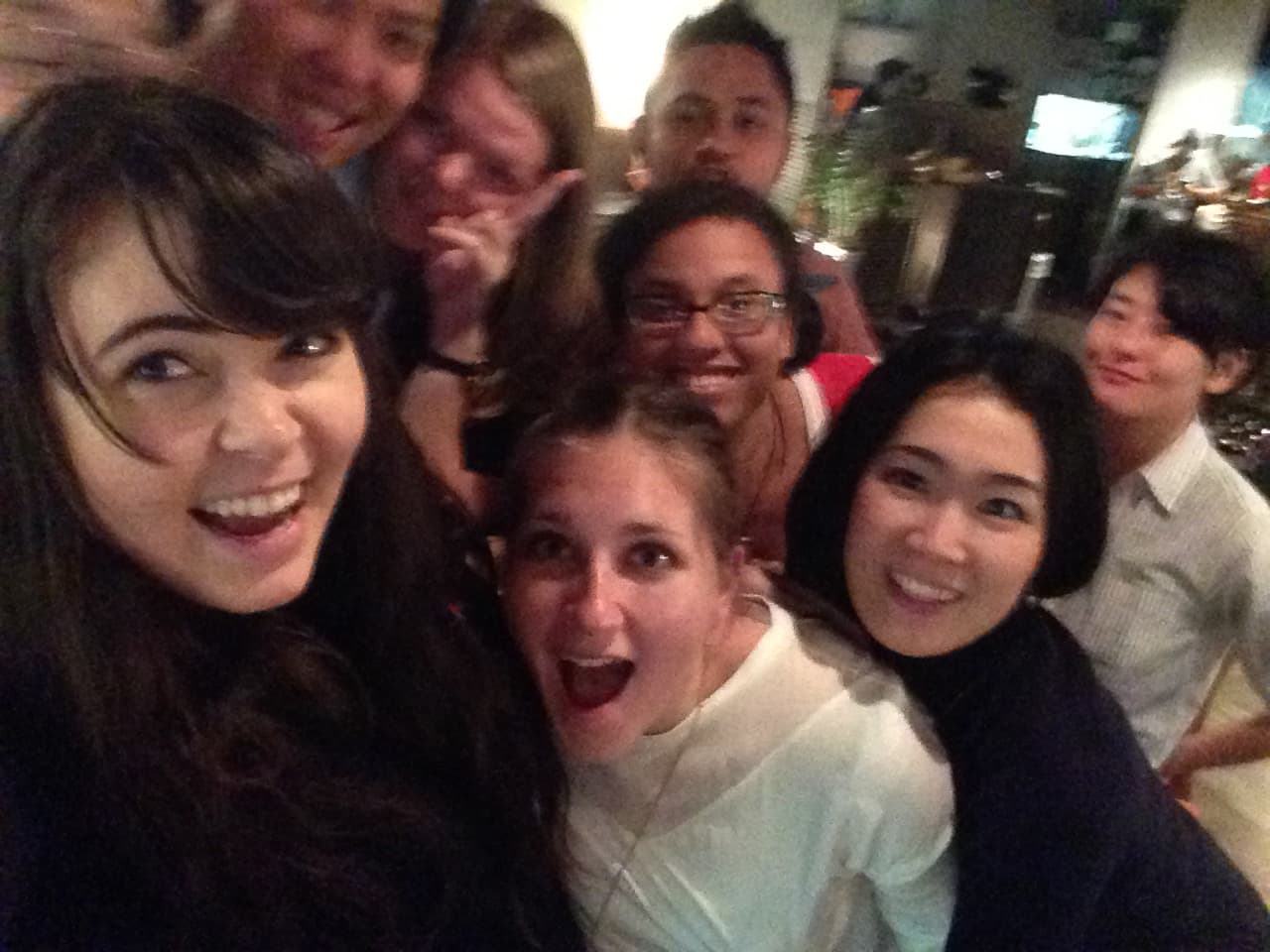
If you’re ever in Matsumoto, visit GNU for drinks one night!
It’s nice to finally meet you all face-to-face 
When I began my study log at the start of 2023, I was scared to join the buzz of a forum of dedicated learners who already seemed to know all of the pathways. I was terrified of posting some new study method and be met with “pfft it doesn’t work like that” or write in Japanese to get “you wrote this incorrectly lol,” but that hasn’t been my experience here at all. Instead, I’ve been met by the most compassionate, understanding, curious, hilarious, supportive people I could’ve ever hoped for on an anonymous forum of studious weirdos 
Every major step I’ve taken has been encouraged by @soggyboy 's magical go-go-go’s, @Akashelia 's advice and prodding of the script writers, @mitrac 's awards and collaboration, and @shuly 's brotherly teasing. I’ve gotten boundless inspiration from @javerend 's many self-challenges, @Malinkal 's amazing reading progress, and @prath 's continued determination to keep moving forward during the many years that we’ve posted alongside each other. And I definitely wouldn’t have spent so many hours on the forum if I didn’t have @hotdogsuplex 's everyday achievements, @Shannon-8 's stream-of-consciousness musings, or @pembo 's inspiring life changes to look forward to when logging in each day.
Discourse is punishing me by only allowing ten pings, so I’m leaving out about 100 vital people who have inspired me and lifted me up as a member of Wanikani. I wouldn’t have made it to 60 without you all-- actually, I probably wouldn’t have made it past 10! Never underestimate the impact you have on a stranger just starting out on their version of the journey that’s become normal for you.
Now, onto the details!


 Goals Going In:
- Figure out how to study Japanese
- Pass Genki II course
 Mistakes Made:
- Buying lots of resource books that all covered the same information
- Buying multiple dictionaries (why did I do this??)
- Not doing nearly any listening immersion
 Primary Accomplishments:
- Experimented with study habits until I understood my personal strengths/weaknesses
- Successfully completed Genki II and Tobira textbooks
- Read my first manga! (君の名は Vol. 1-3) (yes, deciphered rather than enjoyed)
- Took the N3! Got near-perfect on the reading section! Failed the listening section lol
As I mentioned in my opening, my first year began with me having the absolute basic Japanese ability of 1) being able to read hiragana/katakana, and, 2) knowing as far as て-form for grammar. My kanji and vocab were quite nonexistent and I couldn’t read the accompanying passages in each Genki II chapter with any amount of hustle. I did not engage with ANY Japanese media at this point; no anime, manga, games, NHK Easy. Nothing.
Due to the requirements of passing my class, I couldn’t just focus on learning the textbook. Along with reading tests, I was also given oral exams in which I would sit 1:1 with my professor, listen to her questions, and provide adequate answers, both sides 100% in Japanese. I started the year by diving into the following resources:
 Wanikani (kanji)
 Bunpro (grammar)
  Supernative (speaking)
 I almost immediately saw gains in my kanji recognition, becoming the first and sometimes the only student to speak up in class during kanji segments. I became a more confident reader in just a few short months, leading me to join my very first  Read Every Day Challenge here on the WK forums. I was highly intimidated by prose, my mind hearing static whenever I encountered a normal wall of Japanese text like you’d find in any book, so I chose instead to read my first manga: 君の名は.
There’s a simple rule of thumb to keep in mind when reading your first native material that is not a graded reader or a textbook passage:
Your first book will require significant dictionary use. It will not be fun.
The second book, however, will be fun.
It took me one month to read the first volume of 君の名は, but only two weeks to read the second one. Do not give up! Embrace the slog!!
By June of year one, I finished my Genki II class and quickly entered an intensive 3-month Tobira course. Here, I traded out classmates who were casually taking a Japanese class as an elective and traded in peers who were serious JLPT test-takers and were very meticulous about efficiently using every minute of their study time. They were primarily prepping for the N2, where I was more confidently at N4 at that point. For the first time, I was around people who understood the tactics for merging classwork with complementary self-study for maximum gain.
Here’s what I learned from them:
- Prime your studies. Make a list of topics you want to cover prior to sitting down for a study session. Skim your grammar/texts/vocab lists prior to intensively studying them. Disorganization and wavering between choices will kill your focus and the usefulness of your study time.
- It’s obvious when someone engages with Japanese media often. Their vocabulary is wider and language pattern-recognition is better. You are not a better learner for purely engaging with textbooks and educational materials. As I mentioned at the start, I didn’t engage with any Japanese media, but this forced me to overcome ego and lean into the anime, manga, etc.
- The JLPT is not a test of your Japanese ability. It is a standardized test meant to test your Japanese test-taking ability. If you want to take this test, you need to engage with test-specific strategies, not just “learn more.”
From listening to their trial and error, I was able to do some light information gathering for myself and get a better idea of which of my study habits directly contributed to retention. Whenever I would sit down to study for long periods, I would consistently begin to lose focus at around 22 minutes. To combat this, I started splitting my study sessions into 20-minute segments, switching topics when my timer rang, and was suddenly able to sit for very long periods to study without fatigue, as long as I changed topics with my attention span in mind.
For my 3-month Tobira class, I was in the classroom for four hours per day and then studying for four hours each evening. Eight hours of my day spent on Japanese was brutal and not at all a recommended pace. I did crash and burn at one point because it’s simply not sustainable. However, after three months of it, I was more securely in the range of N3.
So I decided to register for the JLPT N3 
After my Tobira class was finished and I was back to only studying for 2-3 hours per day, these are the materials I used to study for the JLPT:
 総まとめ N3 series (for all subjects) link
 新にほんご 500問 N3 (for Q&A practice) link
 スピードマスター (for reading) link
 ToriiSRS (for N-level vocab) link
These are the things I should’ve used to prepare alongside the ones listed above:
 YouTube (for native videos)
 JLPT audio practice (because wtf is that test structure)
After taking the N3 in December, I ended my first year at WK level 24, three manga volumes completed, a long stack of updates in my study log, and an incredible amount of excitement for my second year 


Goals Going In:
- Read 10 manga volumes
- Study for and take the N2
Mistakes Made:
- Didn’t relent studies during rapidly changing life situations
- Beat myself up over not being able to follow a rigid path
Primary Accomplishments:
- Began tracking itemized studying to understand personal trends
- Beat my goal of 10 volumes and finished 42 volumes
- (That comes out to >6300 pages from L20-30 books!)
By the start of my second year, I was finally getting the hang of which resources worked for me, what my next set of goals would be, and how realistically I could visualize my growth by the end of the year. My foundation was set, my baseline was fully established, and I was ready to continuing climbing levels in Japanese.
I wanted to maintain some sort of learning/study structure while no longer being in language classes. After setting my 20-minute timer in every study session during the previous year, I was able to improve my study-time attention span quite a bit and could comfortably increase the time I needed for individual session tasks moving forward. So I spent one hour per day following this structure specifically for learning, not including reading/SRS/casual immersion:
 05:00 NHK Easy news article
- 40:00 Grammar (using the JLPT Sensei ebook)
- 05:00 Vocabulary (10 new terms, handwritten)
 10:00 Listening Comprehension
This routine worked well for me during my JLPT “off-season,” where I was focused on exposure to new items rather than intense review of known items prior to the exam. By this time, I knew my weaknesses well, and knew that if I studied anywhere that wasn’t entirely devoid of all distraction then I wouldn’t make it through the hour with these four tasks completed. Picture me spending an hour per day in a completely bare room with only a desk and chair 
At this point, I was aiming for the N2 in the next December on my roster, so I was also adding in a few  新にほんご 500問 N2 (link) pages each day for more JLPT-style Q&A practice. Around the middle of the year, I also started tracking the time I spent doing listening immersion, inspiration courtesy of Javerend’s 100-hour listening report.
But nothing is meant to be perfect forever! I was still in school at this time, which meant I would eventually graduate, get the boot from my university apartment, and need to find a job. All things that do not mix well with a rigid learning schedule.


Rapidly walking away from the camera because I was worried they’d start graduation without me
(they didn’t)
June blasted my carefully laid study plans into smithereens and I simply wasn’t prepared for it. I became very restless and agitated when I was no longer making the same gains as before, even though it was due to my belongings being in boxes and job interviews becoming the most important tasks on my plate.
However, without physical JLPT materials in hand any longer, I was really only able to read. I finished volume after volume of manga. I quickly filled up each square on my Manga Bingo card. I used my downtime to set up the first  Summer Solstice 24-hour Readathon, starting it as a way to share a reading day with WK friends but accidentally creating an event that allowed (and still allows) me to track my reading gains each quarter.
Eventually landing a tough new job and still having an upended living situation, I continued far into the year unable to resume my JLPT-specific studies. When registration came and went in September of my second year, I mourned the failure of the goals I’d set back in January. It was the first time I’d had to contend with something other than unwavering upward momentum. But without it, I don’t think I would’ve been able to read anywhere near as many volumes as I did, which did wonders for expanding my vocabulary, putting grammar in context, and allowing me to read Naruto without it being weird. (join the naruto book club  ) (WHO SAID THAT?)
When the end of the year rolled around, my bingo card was filled, I’d finished over 6300 pages from 40 different manga, increased my comfortable reading level from L22 to L28, hosted three different readathons, and ended at WK level 42 

Goals Going In:
- Finally read one (1) full-length novel in Japanese
- Take the N2, for real this time
- Watch more anime without subtitles
Primary Accomplishments:
- Finished two novels! At least one more on the horizon before the year is over
- N2 is registered for, though still a few months away
- Finished the entirety of Bleach without subtitles (400+ episodes
 )
)
Foregoing the Mistakes section as year three is still in the works and I can’t use the power of hindsight on the present My goals this year have been more narrow than the previous two years: read a novel, and take the N2.
Last year, in year two, I’d foolishly held onto the notion that once I got decent enough at reading manga, I’d naturally transition over to reading novels. As though one is a track that leads to the other. This is not the case at all! Manga and novels require two completely different reading skillsets, and while I’d honed the skills required to follow the context of manga at an N2 level, my novel-reading skillset was (as I’d sadly realize very quickly) still as sluggish as it was back when I was struggling through the vertical text in Genki II and Tobira 
So, at the start of the year, kittyaphrodite and I were entered into a contract:
When reading lots and lots of manga, you become adept at using visual context to fill in the blanks of the succinct writing, as well as in deciphering the slang/casual/clipped speech prevalent in speech bubbles. While the text is vertical, there’s usually not much more than a few lines together at a time, which doesn’t help to get over textwall anxiety. Which I experienced very, very much of.
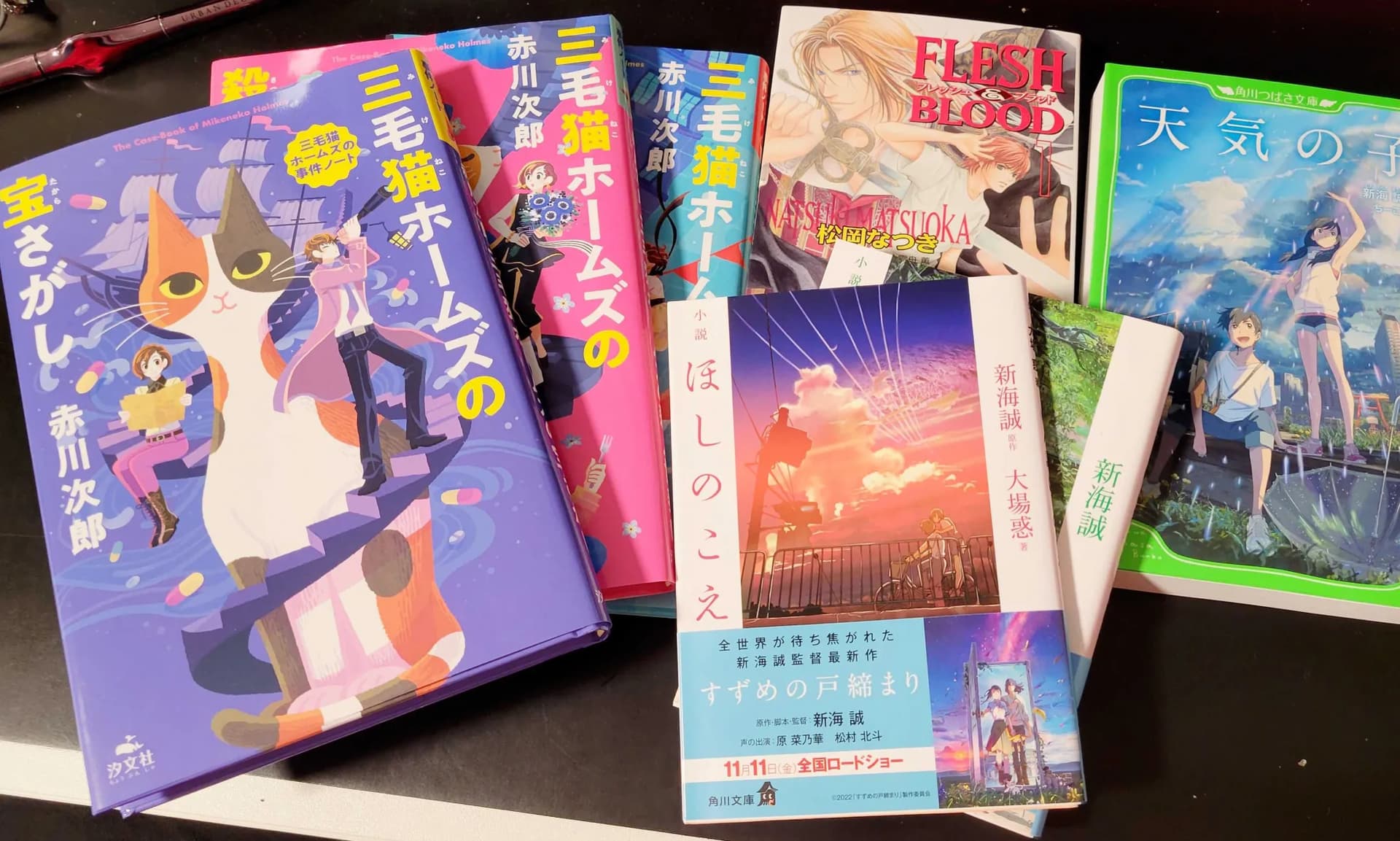
The novel I chose for my first foray into the world of vertical text was すずめの戸締まり, which is the novelization of the 2023 film ‘Suzume’. I chose this book because I’d recently seen the movie and figured that, if I ever got lost in the words of the book, I could use my memory of the film to help provide context for the vocabulary. Honestly, I think that this was good reasoning and I’d choose it again if I had to.
It was a slow process. I found that I was far more comfortable reading the physical edition of the book, despite also owning the ebook, but building the “vertical flow” skill that we have as horizontal-text readers took me a long time. I probably spent an entire month on the introductory 25 pages alone. Much like when reading my first manga back in year one, building the vertical skill does not have a workaround. You simply have to endure it at the beginning, embrace the slowness, until one day you’ve finished two pages instead of one. Then five instead of two. Then ten. And so on.
Something that did help me – and doesn’t necessarily qualify as a workaround but definitely helped build my vertical textwall confidence – was pausing the tiny-font L29 Suzume novel for a month or two while I read a big-font L21 children’s novel. The content was technically far below my vocabulary level, but I needed that confidence boost while continuing to build the vertical flow skill. And when I finished 三毛猫ホームズの宝さがし, I returned to Suzume’s itty-bitty text with an improved ability to read vertically and was able to put away 15-20 pages in a day. At the end of the novel, I read 20-30 pages.
Your first vertical text novel will hurt your brain. It will not be fun.
The second book, however, will be fun.
Now that I’ve finished two novels and will no longer be turned into a frog, I’m excited to continue reading even more! I hope to someday have a 40-novel year the way I had a 40-manga year. I’m certainly not suddenly a fast reader, nor very strong, and I still have more headway to make in improving my vertical text flow. But I no longer hear the static in my head when I encounter a dense page of kanji, which is something I consider to be one of the greatest achievements of the three years in question 
After all, it’s as the Reading Master says,
For right now, near the end of year three, I’m registered for the JLPT N2 and I’m excited to see the score I get!
My N2 study materials are similar to my N3 materials, with just a few small changes:
- 総まとめ N2 (reading, grammar, vocab) link
 日本語の森この一冊で合格する N2 (JLPT Q&A) link
- ToriiSRS (vocab) link
- 日本語の森 website (grammar, listening) link
- Youtube (listening) you don’t need a link, right?
I have about 50 days left until the test – make sure to peek into my study log in December to see how it goes 


That was my first time ever making and decorating a cake It looked a little funny but it tasted delicious! Which I think is as accurate of an account I can give about my entire learning journey, so it fits very well into the story of reaching level 60 I chose blue, pink, and purple sprinkles for radical, kanji, and vocab categories. And I did a little surgery on an undersea cake decorations kit in order to get something resembling a crabigator  了!
了!
There’s so much more I want to say, but I’ve been working on this post for three days and I simply cannot put any more words in here without firmly crossing the line from informative to sappy and sentimental (as if that’s ever stopped me before, pfft).
Thank you again to every single person who has ever left a comment on my study log, joined in on a readathon, joined the Naruto Book Club (), or shared memes with me in POLL  It’s not my intention for this post to be a goodbye (and, boy, do those reviews still continue to pour in), so we’ll definitely continue to see each other around! In the meantime, read some manga, try out a novel, excuse my typos as I’m sure there are many, and don’t forget to embrace the slog!


I don’t know how to end a topic without a poll, so please choose yourself some new taiyousea’s-level-60-post-related durtles from the list below:
 Lumberjack Durtle (study logging is your passion)
 Durttebayo (naruto book club calls to you )
 Durting Abroad (brb heading to japan)
- The Main Characdurt (ready to start reading a new book)
- The 24-hour Durtathon (when’s the next event??)
“it’s gonna take forever to learn japanese”
the time will pass anyways

 now I go read the post


 my interest for becoming better at those languages also dropped fast. It’s definitely the more, the merrier! And at the same time, just because it’s popular doesn’t mean there’s a great community (as you also mentioned with a particular subreddit), so being even more grateful for the magic community we have here


 and started using emoji because of you


 I just feel like it’s one of those cases where, despite our experiences being quite different, the ambitious energy present is the same. (Not to toot my own horn, lmao. Not sure how to better phrase that.)